


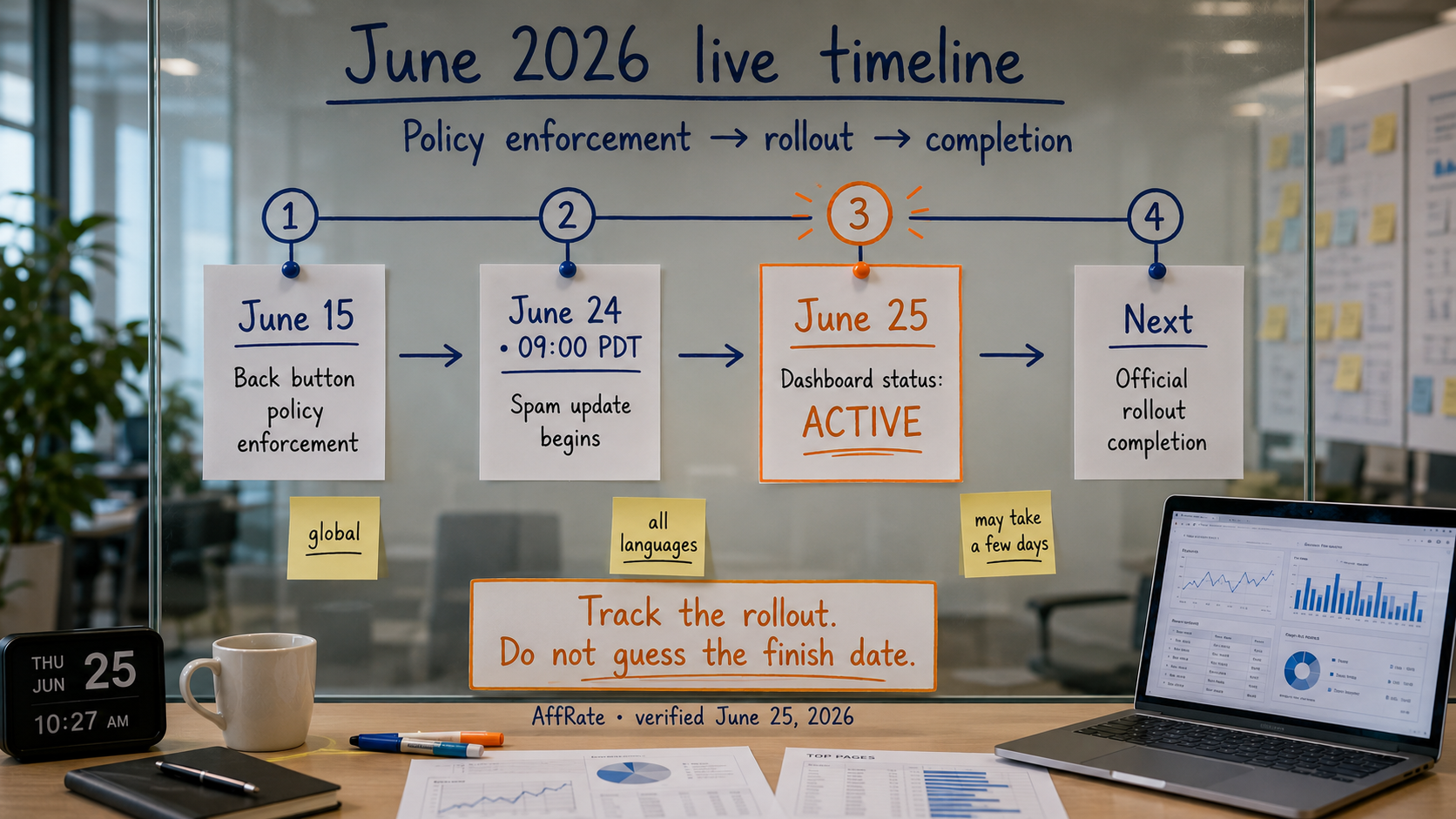
Google’s June 2026 spam update is live. It started on June 24 at 09:00 PDT, applies globally and to all languages, and may take a few days to finish. At the time of this update, Google’s dashboard still marked the rollout as active.
#ad disclosure: This post may contain affiliate links. AffRate is an informational resource, not a gambling operator. 18+ only. Legal and regulated regions only. Offers vary by location. Please play responsibly.
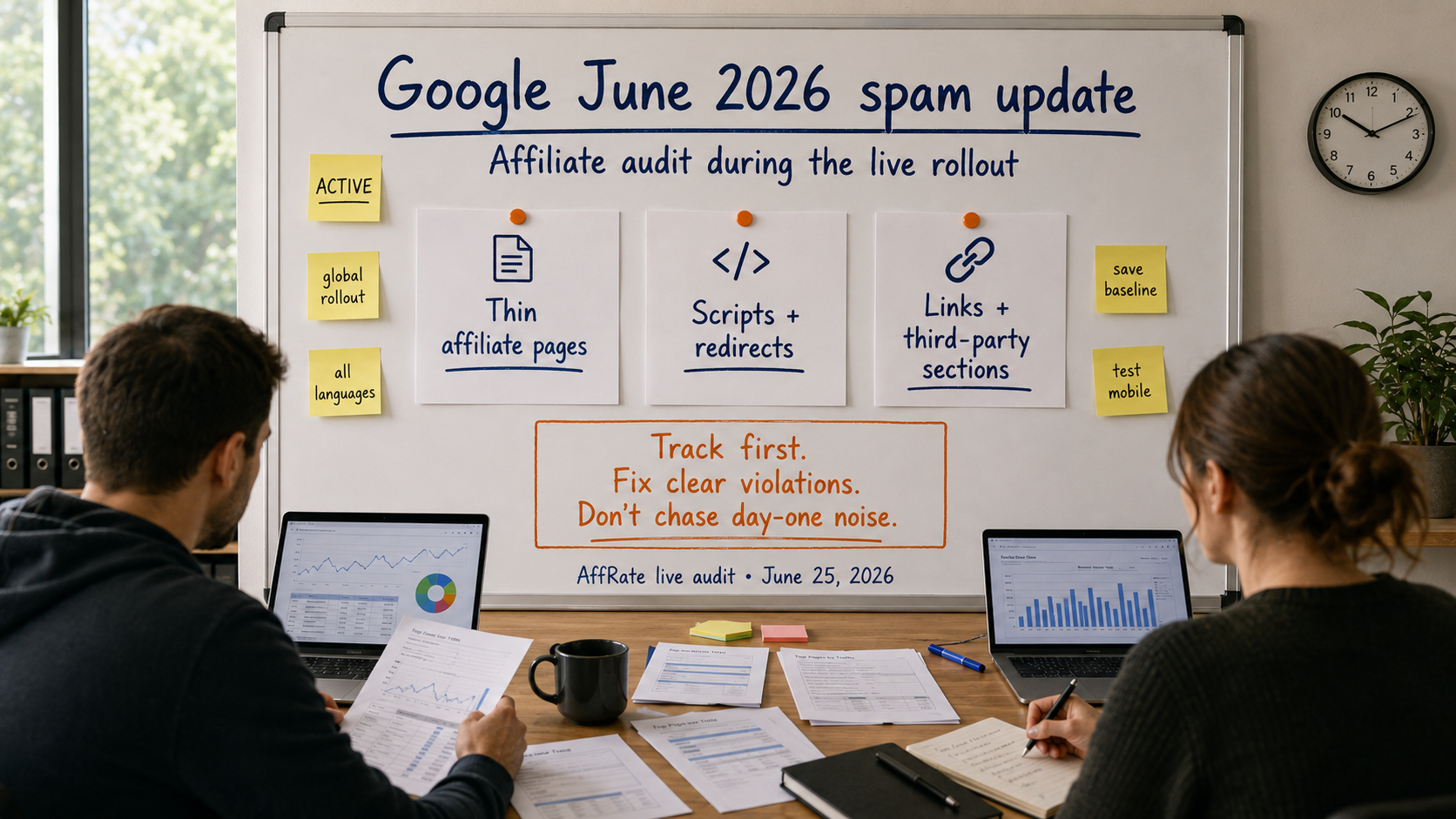
Live update: Google has not named any specific targets for this rollout. This guide uses Google’s current spam policies as an audit framework. It does not claim that every policy listed below was changed on June 24.
Not legal or ranking advice: Search performance can change for many reasons. Check your own data, scripts, links, page templates, and commercial relationships before making site-wide changes.
Google June 2026 spam update: quick summary
- Start date: June 24, 2026 at 09:00 PDT.
- Current status: still active when this article was updated on June 25.
- Coverage: global and all languages.
- Expected duration: Google says the rollout may take a few days.
- Named targets: Google has not published a rollout-specific list.
- Best action now: record your baseline, inspect clear spam risks, and avoid reacting to one partial day of data.
This is not a replacement for our earlier Google March 2026 update audit. That guide focused on the March core update and the first back-button policy announcement. This article is about monitoring and auditing during the new June spam rollout.
What Google confirmed — and what it did not
The official announcement is short. Google says it released a spam update that applies globally and to all languages. It also says the rollout may take several days.
That is all Google has confirmed so far. It has not said that the update is aimed at affiliate sites, AI content, expired domains, guest posts, or any one vertical.
Do not treat early case studies as confirmed causes
Some sites will report gains or losses before the rollout ends. That can be useful context. But it does not prove why a site moved.
For example, a review site may lose traffic while also having indexing issues, seasonality, changed search demand, or a recent template release. Therefore, check the pattern before blaming the update.
The first day of Search Console data is incomplete
Search Console offers a 24-hour view, but Google marks that data as preliminary. A partial Thursday should not be compared with a full Thursday.
Instead, save the data as a baseline. Then compare full days, the same weekdays, and separate page groups after more data arrives.
Fix clear violations now
You do not need to wait for the rollout to finish before removing an obvious problem. If a script traps the back button, a paid link passes ranking credit, or a page copies merchant content with no added value, fix it.
But do not rewrite a healthy site because one query moved for a few hours.
Google June 2026 spam update: affiliate risk areas
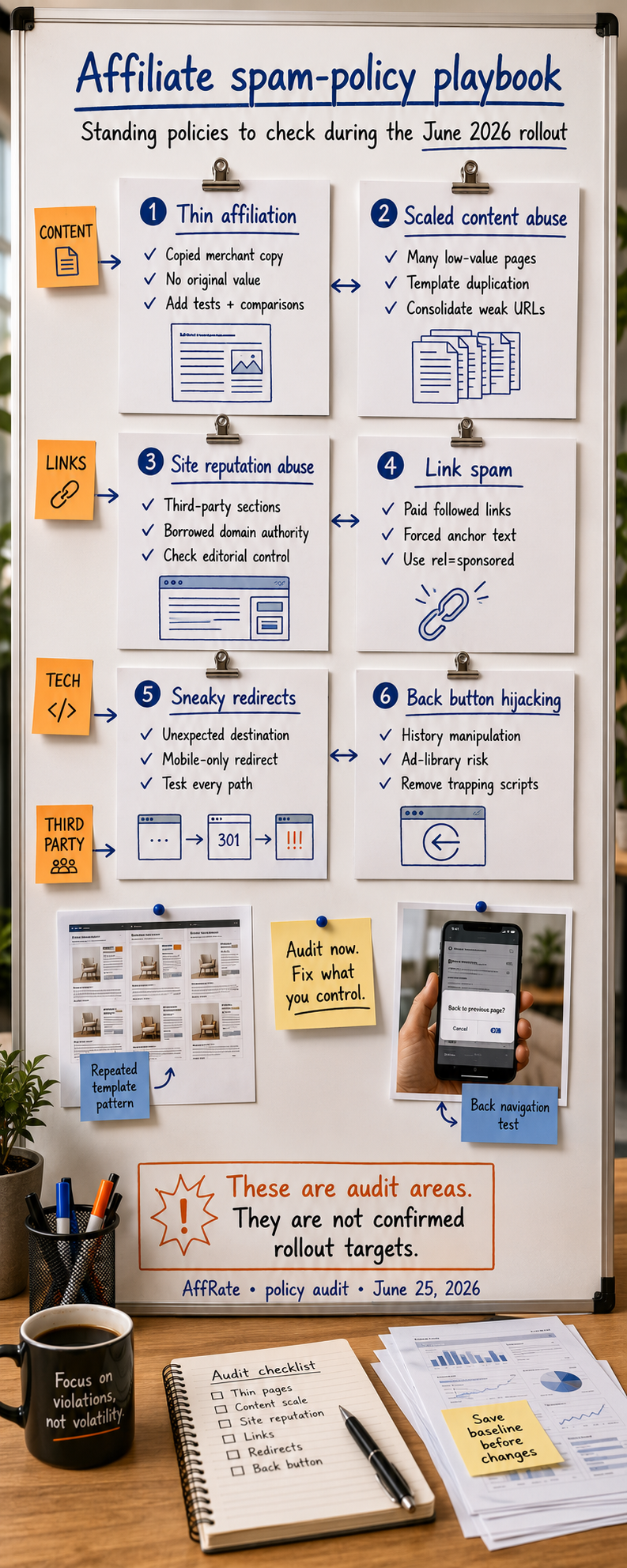
The table below is based on Google’s standing spam policies. These are sensible areas to check. They are not a list of confirmed June update targets.
| Policy area | Common affiliate pattern | Fast check | Suggested action |
|---|---|---|---|
| Thin affiliation | Merchant descriptions, copied terms, and generic reviews with affiliate links. | Remove the links and ask whether the page still helps someone make a decision. | Add original analysis, tests, comparisons, screenshots, pricing context, or useful navigation. |
| Scaled content abuse | Large numbers of near-identical reviews, location pages, bonus pages, or AI-generated lists. | Compare 20 pages from the same template and mark what is truly unique. | Consolidate weak pages and add real editorial value to pages that remain. |
| Site reputation abuse | White-label reviews, coupons, casino pages, or sponsored sections placed mainly to use a domain’s authority. | Ask why the content is on this domain and who controls its editorial decisions. | Remove ranking-led third-party sections or bring them under genuine first-party editorial control. |
| Link spam | Paid guest posts, partner links, advertorial links, or commercial links that pass ranking credit. | Export outbound links from sponsored and partner content. | Use rel="sponsored" for paid links and remove forced keyword-rich anchors. |
| Sneaky redirects | Mobile users, certain countries, or ad visitors are sent somewhere they did not expect. | Test URLs on mobile, desktop, incognito mode, and several locations. | Remove deceptive redirects and document valid geo or login redirects. |
| Back button hijacking | Ad scripts, interstitials, redirect tools, or JavaScript add unwanted browser-history entries. | Open a page from search, interact with it, and press Back once. | Remove the script, library, import, or configuration causing the history trap. |

Thin affiliation: links are not the problem
Google does not say that affiliate links are automatically spam. The problem is publishing merchant content without adding anything useful.
A useful affiliate page may include original reviews, testing, ratings, comparisons, price context, category navigation, or a clear decision framework. The exact format can vary. The added value should be easy to see.
AffRate uses a published scoring framework for the same reason. You can review it on our affiliate portal methodology page.
Scaled content abuse: the method is not the main issue
Google defines scaled content abuse as publishing many pages mainly to manipulate rankings instead of helping users. It can involve AI, scraping, translations, stitched content, or manual production.
So “written by a person” is not a defence. And “made with AI” does not automatically mean spam. The key question is whether the page adds value and exists for a real audience.
Site reputation abuse: check third-party sections
Third-party content is not banned. The risk appears when content is placed on an established domain mainly to borrow its ranking signals.
Review white-label sections, sponsored review hubs, coupon folders, guest-created comparison pages, and content supplied by partners. Check topic fit, editorial control, disclosure, ownership, and the reason the page exists.
Link spam: qualify commercial relationships
Google recommends marking advertisements and paid placements with rel="sponsored". The older nofollow value is still accepted, but sponsored is more specific.
<!-- AFFILIATE / PAID LINK EXAMPLE -->
<a href="https://partner.example.com/offer"
   rel="sponsored nofollow">
  Visit partner
</a>
Also review guest posts and advertorials. Payment can include money, products, services, free access, or another commercial benefit.
Back button hijacking: check the ad stack
Google began enforcing its explicit back button hijacking policy on June 15, 2026. The June spam update started nine days later. That timing does not prove the two are directly linked, but the technical risk is active now.
Google says the issue can come from included libraries or advertising platforms. Therefore, test the full production page. Testing only the clean WordPress template may miss the problem.
72-hour audit during the Google June 2026 spam update
This plan is designed for a live rollout. The goal is to separate evidence from noise and fix only what is clear.
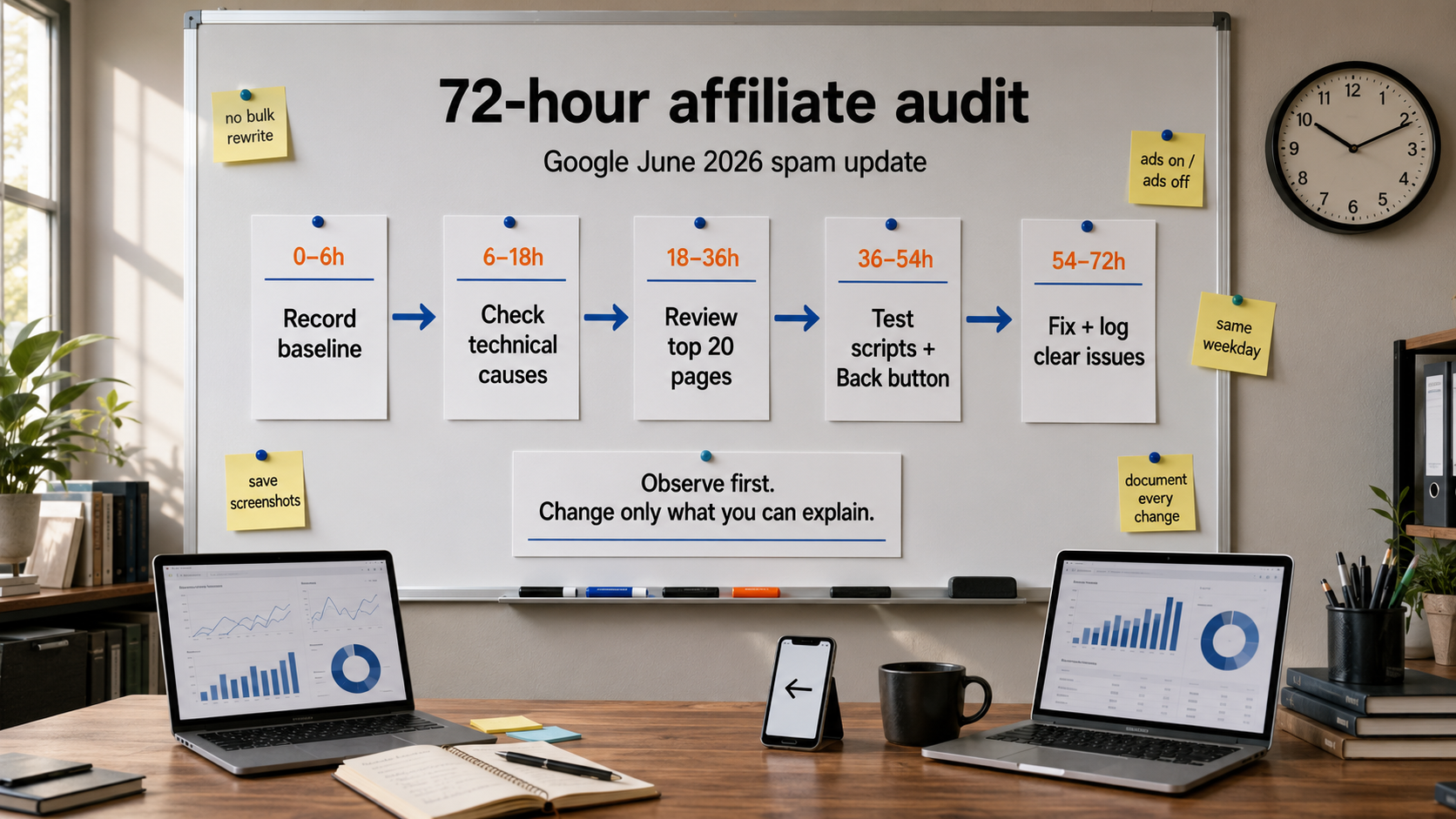
0–6 hours: record the baseline
- Add a June 24 annotation to your reporting dashboard.
- Export the last 28 days of Search Console data.
- Save clicks, impressions, CTR, and average position.
- Export your top pages and queries.
- Record any deployments made during the previous two weeks.
Do not deploy a large redesign at this stage. You need a clean timeline.
6–18 hours: check for non-ranking causes
- Open the Manual Actions report.
- Check Security Issues.
- Check Page Indexing for a new spike in excluded URLs.
- Review server uptime and crawl errors.
- Check whether tracking, consent, or template changes affected reporting.
A traffic drop can come from a technical issue, security issue, changed demand, or reporting problem. Do not skip this step.
18–36 hours: inspect the top 20 commercial pages
Start with pages that combine traffic and revenue. Do not begin with hundreds of low-value URLs.
For each page, check:
- How much of the copy comes from an operator, merchant, feed, or partner?
- Does the page contain first-party research or useful analysis?
- Are ranking criteria explained?
- Are claims supported?
- Are affiliate and sponsored links marked correctly?
- Does the page work without intrusive ads or redirects?
36–54 hours: test scripts and browser behaviour
Test important templates on a real phone and desktop browser. Use normal mode and incognito mode.
- Open the page from a search result or external link.
- Accept or reject the consent banner.
- Close any ad, pop-up, or interstitial.
- Click one internal tab or comparison filter.
- Press the browser Back button once.
- Confirm that you return to the page you came from.
Then repeat the test with ads and third-party scripts disabled. This helps isolate the source.
54–72 hours: fix and log clear issues
Make changes where the evidence is clear. Examples include copied descriptions, deceptive redirects, unqualified paid links, or history-manipulation scripts.
Keep a record of every change:
<!-- AFFRATE JUNE 2026 UPDATE LOG -->
<details class="affrate-updates">
  <summary><strong>Google June 2026 spam update log</strong></summary>
  <ul>
    <li><strong>June 25, 2026:</strong> Recorded Search Console baseline and reviewed top commercial pages.</li>
    <li><strong>June 25, 2026:</strong> Tested back-button behaviour with the full ad and consent stack.</li>
    <li><strong>June 25, 2026:</strong> Updated sponsored-link attributes and removed one deceptive redirect rule.</li>
  </ul>
</details>
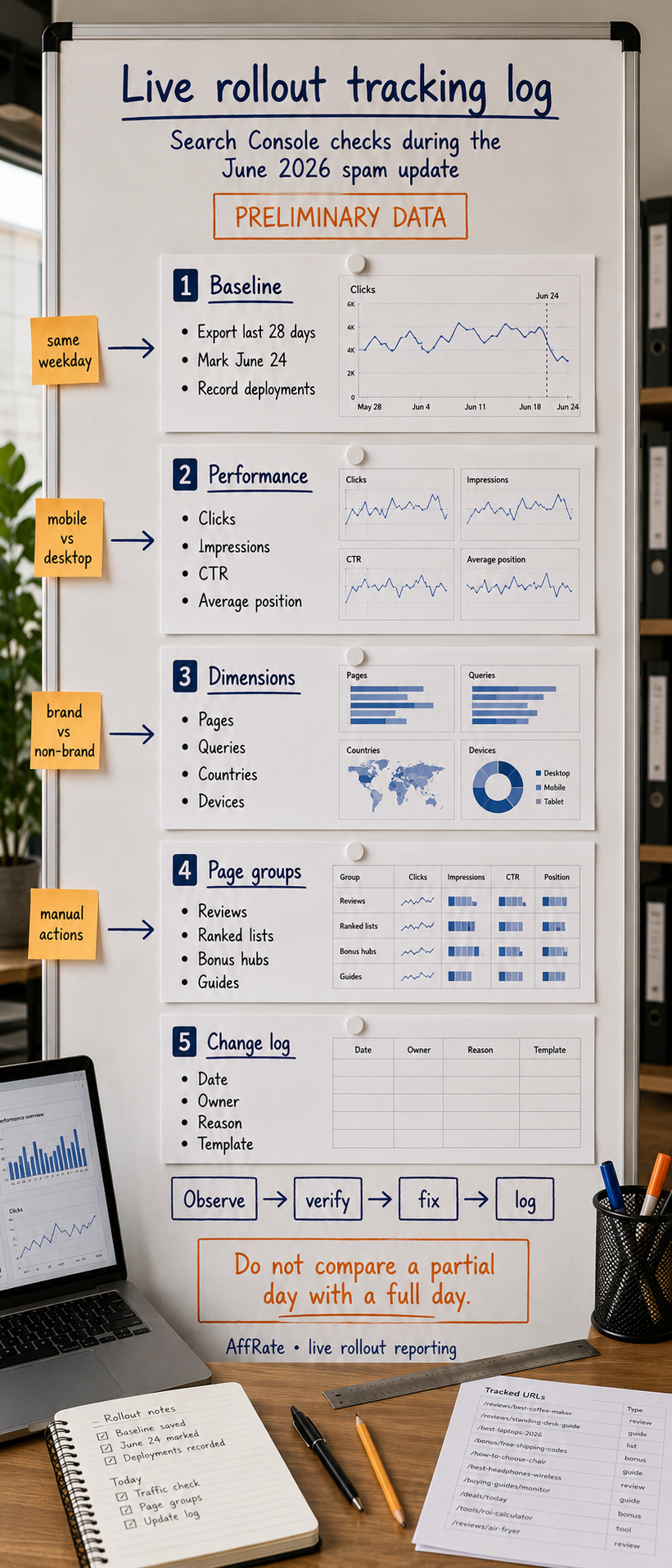
Search Console tracking during the live rollout
Search Console is useful here, but the first data points are not a final result. Use them to build a record.
| Field | What to record |
|---|---|
| URL | The exact landing page. |
| Page type | Review, comparison, ranked list, bonus page, news post, guide, or directory page. |
| Clicks | Current period and comparison period. |
| Impressions | Use this to separate visibility loss from CTR changes. |
| Average position | Look for large and persistent changes, not small daily movement. |
| Country | Check whether the change is global or limited to one market. |
| Device | Separate mobile and desktop. |
| Policy flags | Thin content, scaled pages, paid links, third-party sections, redirects, or script issues. |
| Changes made | Date, owner, reason, and affected template. |
Compare the right periods
For early monitoring, compare the same weekday with the previous week. Once the rollout ends, compare complete periods of equal length.
Also separate:
- Brand and non-brand queries.
- Mobile and desktop.
- Main target countries.
- Review pages and informational pages.
- Recently updated pages and untouched pages.
Watch clicks and impressions together
If impressions fall, the page may have lost visibility. If impressions stay stable but clicks fall, the cause may be CTR, a changed result layout, or a different title and snippet.
Average position can help, but it should not be the only measure.
Check Manual Actions separately
A manual action and an automated ranking change are not the same thing. The Manual Actions report can tell you whether Google has issued a manual penalty.
A clean report does not prove that automated systems made no change. It only means no manual action is listed.
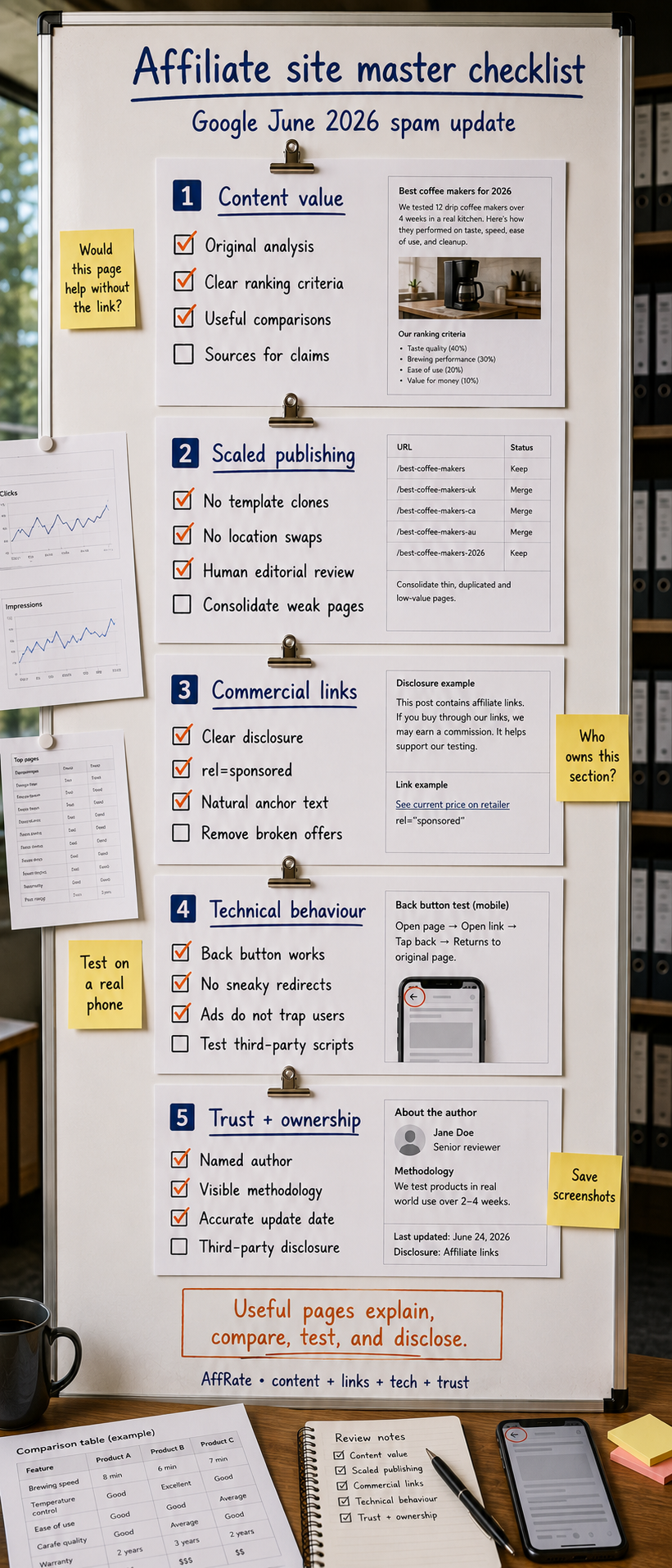
Affiliate content checklist after a spam update
Use this checklist on reviews, ranked lists, comparison pages, directories, and bonus hubs.
Content value
- The page answers a clear user question.
- The main text is not copied from a merchant or operator.
- The author adds analysis, testing, research, or a useful framework.
- Ranking criteria are explained.
- Readers can understand why one option ranks above another.
- Claims and numbers have sources.
Scaled publishing
- Pages made from the same template contain meaningful differences.
- Country pages are not simple name swaps.
- AI-assisted content has been reviewed and improved by an editor.
- Weak duplicates are consolidated or removed from search.
- Publishing volume is tied to real editorial capacity.
Commercial links
- Affiliate and paid links use
rel="sponsored". - Commercial relationships are disclosed clearly.
- Anchor text is written for readers, not ranking manipulation.
- Partner agreements do not require followed links.
- Expired offers and broken landing pages are removed.
Technical behaviour
- The browser Back button works normally.
- Mobile users are not sent to unexpected domains.
- Ads do not cover the main content.
- Consent tools do not create navigation traps.
- Redirect rules are documented and tested.
- Third-party scripts are reviewed regularly.
Trust and ownership
- The author or editorial team is named.
- The review method is visible.
- Update dates are accurate.
- Third-party contributions are disclosed.
- The content fits the site’s main subject.
- Sponsored sections have real editorial oversight.
For a broader publishing framework, read the AffRate AI and SEO playbook. It covers data, editorial review, and practical use of AI in affiliate workflows.
What not to do during the rollout
Do not rewrite every page at once
Large untracked changes make analysis harder. Fix clear violations first. Keep healthy pages stable until you have enough data.
Do not assume every loss is a penalty
Traffic can fall because of demand, seasonality, indexing, tracking, technical problems, or changed search layouts. Check those before making a spam diagnosis.
Do not remove every affiliate link
Affiliate links are not automatically a violation. The page needs added value, clear disclosure, and correctly qualified commercial links.
Do not publish “recovery” content at scale
Creating hundreds of rushed pages in response to a spam update can make the original problem worse.
Do not leave deceptive scripts live
If a redirect, ad library, or history script traps users, remove it now. That is a clear user problem even before you consider rankings.
Compliance and responsible gambling
SEO changes should not remove compliance controls from iGaming pages. Keep disclosures, legal-region checks, age messaging, and responsible gambling information visible.
- #ad disclosure: place it above the first commercial link.
- 18+: keep the age requirement visible.
- Legal regions only: do not show offers where they are not permitted.
- Responsible gambling: keep support information and safer gambling language available.
- No misleading claims: avoid “guaranteed”, “risk-free”, and similar wording.
See the full AffRate affiliate compliance guide and our Responsible Gambling resources.
FAQ: Google June 2026 spam update
Is the Google June 2026 spam update finished?
No. When this article was updated on June 25, Google’s dashboard still marked it as active. Google says rollout may take a few days.
What is the Google June 2026 spam update targeting?
Google has not published a rollout-specific target list. The official announcement only confirms that it is a global spam update covering all languages.
Is Google targeting all AI content?
Google has not said that. Its scaled content policy covers large amounts of low-value content regardless of how it was created. AI can be part of the process, but the policy is about purpose, scale, originality, and user value.
Should I delete thin pages during the rollout?
Review them first. Improve pages that serve a useful purpose. Consolidate duplicates. Remove or exclude pages that have no real value. Do not delete large sections only because of one day of movement.
How long can spam-update recovery take?
Google says improvements may appear after its automated systems learn that the site complies with spam policies. That process can take months.
Is back button hijacking part of this update?
Google has not said that it is a specific target of the June rollout. However, the separate back button policy has been enforceable since June 15, so it belongs in the current audit.
What should I update when the rollout finishes?
Add the official completion date, replace preliminary comparisons with complete periods, and publish a short change log showing what moved and what was fixed.
Sources (verified June 25, 2026)
- Google Search Status Dashboard — June 2026 spam update
- Google Search Central — Google Search spam updates and your site
- Google Search Central — Spam policies for Google Web Search
- Google Search Central — Back button hijacking spam policy
- Google Search Console Help — Performance report
- Google Search Central — Debugging drops in Search traffic
- Google Search Central — Qualify outbound links
- Google Search Central — How to use Search Console


