


Updated: May 4, 2026 — Amazon’s April 14, 2026 Associates update is not just a wording refresh. It changes how affiliates should think about paid traffic, onsite commissions, original content, disclosure, and product-review pages that rely too heavily on copied product data.
#ad disclosure: This post may contain affiliate links. AffRate is an informational resource, not a gambling operator. 18+ only. Legal/regulated regions only. Offers vary by location. Please play responsibly.
Not legal advice: This is an editorial and operational checklist for affiliate publishers. Amazon program rules, FTC requirements, and local disclosure laws can change, so confirm your own implementation with your account, counsel, and compliance team.
Amazon Associates 2026: TL;DR for affiliates
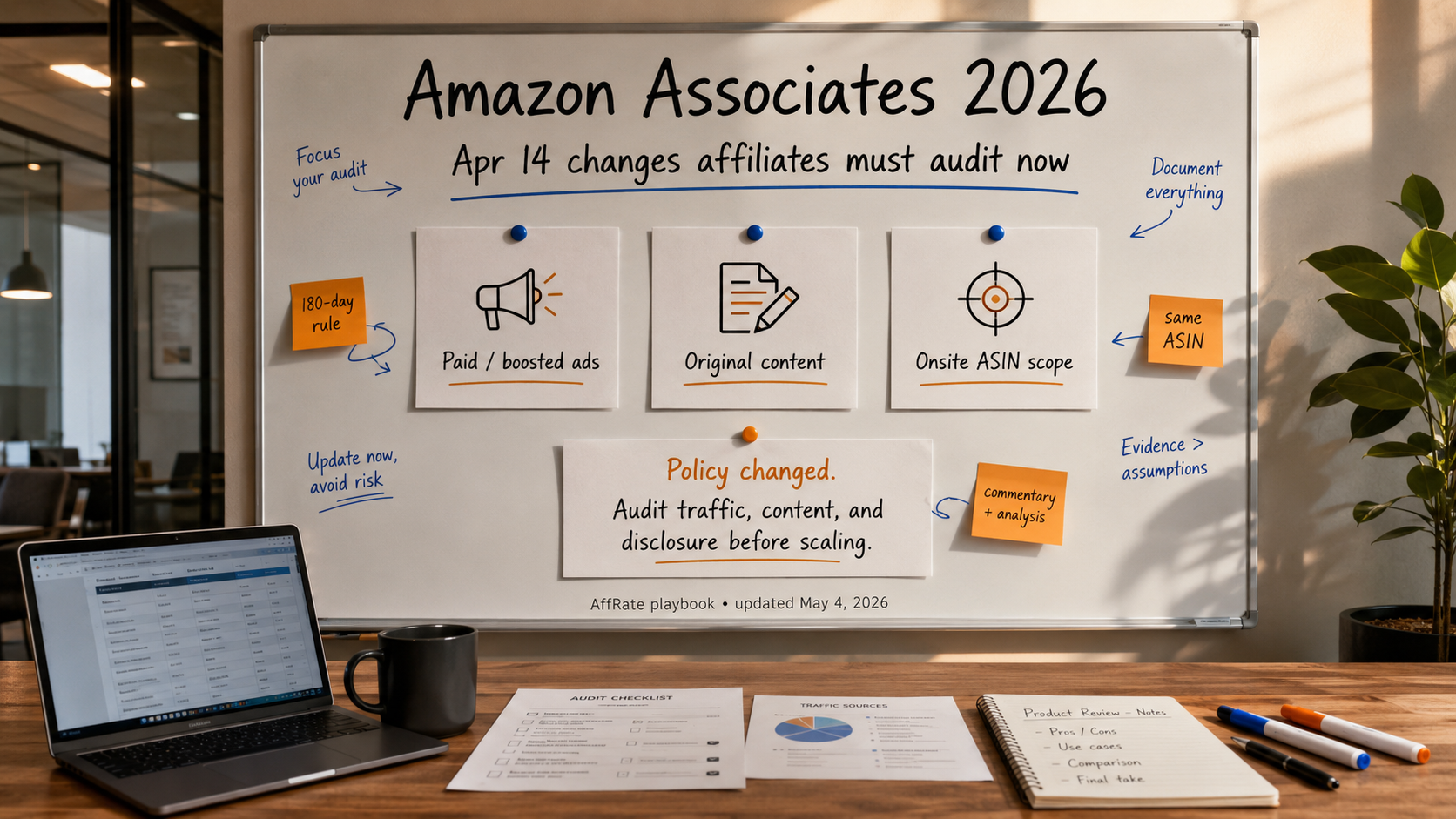
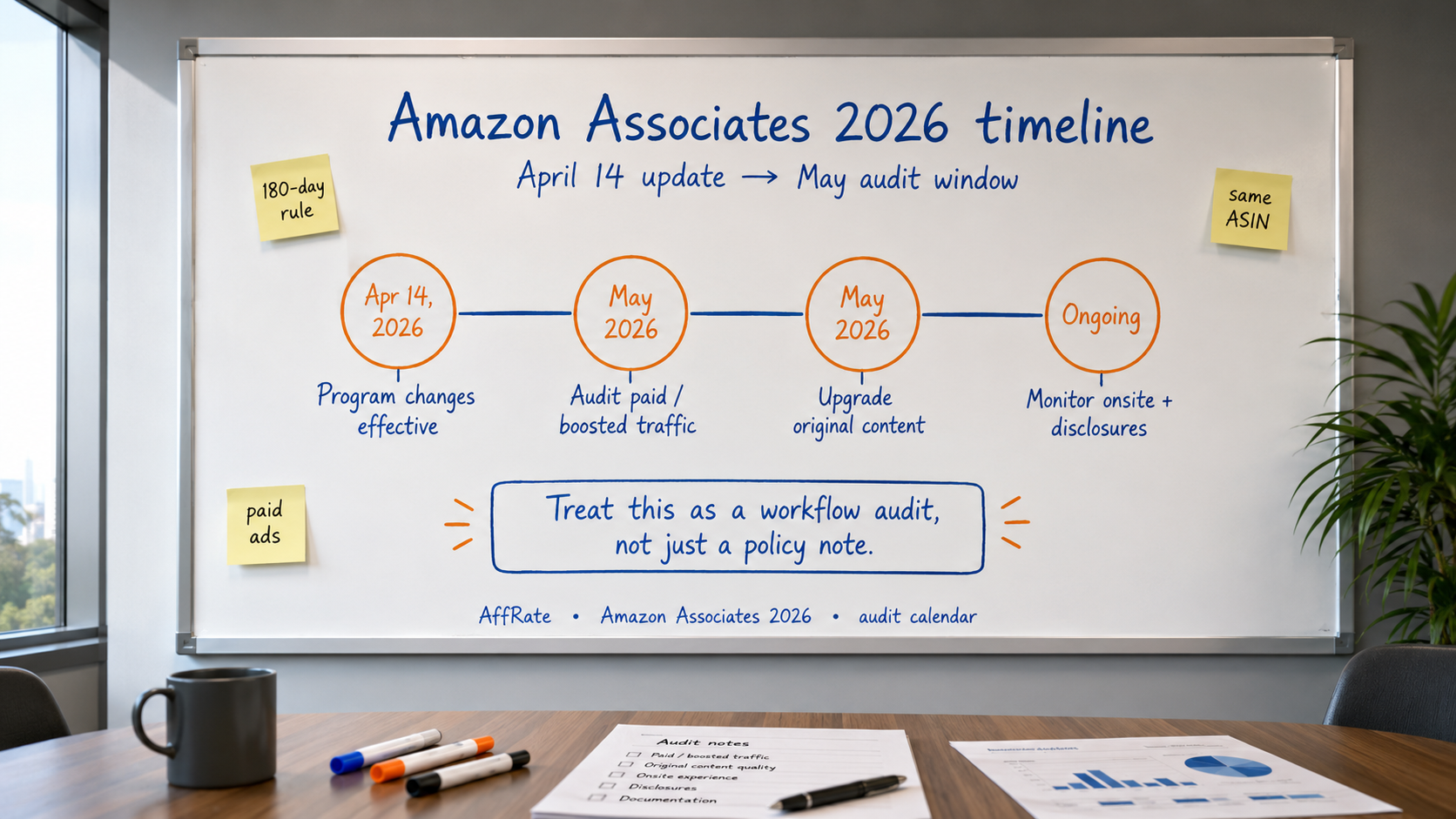
- Effective date: Amazon’s “What’s Changed” page says the relevant Operating Agreement and Program Policies updates are effective April 14, 2026.
- 180-day qualification rule: Amazon says it added a 180-day time limit requirement for products to be shipped, streamed, downloaded, and paid for by the customer to qualify for commission.
- Paid / boosted ad risk: Amazon expanded disqualified purchases to include products purchased by customers referred through any paid or boosted advertisement linking to Amazon, with limited exceptions.
- Onsite commission scope: Amazon says onsite commission calculation now applies only to Direct Qualifying Purchases of the same ASIN variant as the linked product detail page.
- Original content standard: Amazon added a definition requiring original content to contain commentary, analysis, or transformation for additional value.
For AffRate’s broader approach to transparent affiliate evaluation, see Affiliate Portal Scoring Methodology. Additionally, if you run an affiliate portal and want it reviewed, use Submit Your Site.
Amazon Associates 2026: what changed on April 14
The headline is simple: Amazon is narrowing ambiguity around what qualifies, what traffic is risky, and what counts as meaningful content. However, the operational impact is bigger than one line in a policy page.
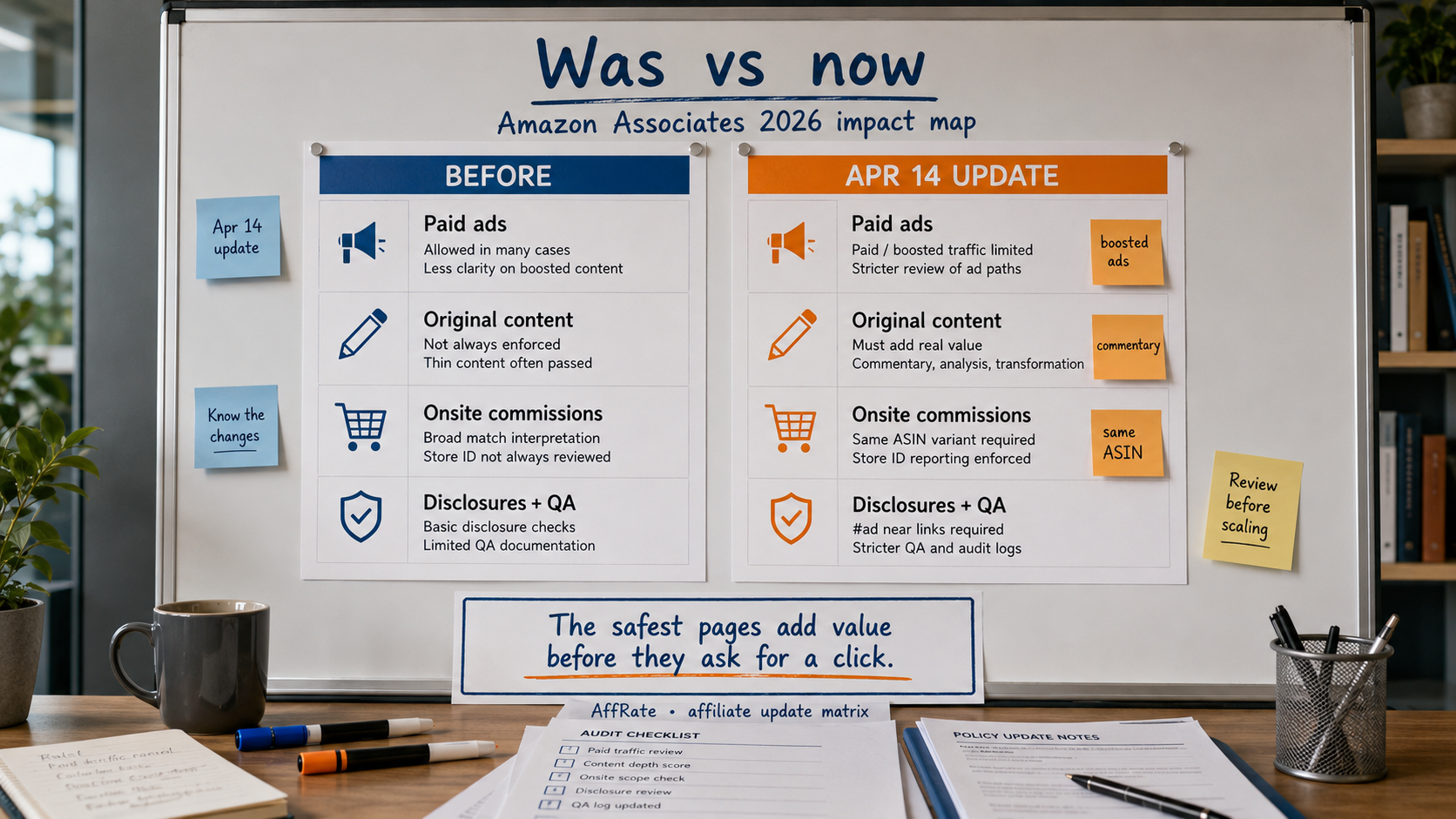
| Area | What Amazon changed | Affiliate impact | What to audit first |
|---|---|---|---|
| Qualifying Purchases | Added a 180-day time limit requirement for shipped / streamed / downloaded / paid products. | Delayed fulfillment and edge-case reporting need closer review. | High-ticket products, pre-orders, delayed shipping categories, and reporting anomalies. |
| Paid / boosted ads | Expanded disqualified purchases for customers referred through paid or boosted advertisements linking to Amazon. | Direct-to-Amazon ad flows can become commission-risky. | Paid social, creator boosts, search ads, native ads, and landing pages. |
| Onsite commissions | Updated onsite commission scope to same ASIN variant as the linked Product detail page. | Creators should not assume nearby variants or broad product-family purchases will qualify onsite. | Storefront videos, Idea Lists, product detail page placements, and variant-specific content. |
| Original content | Added a definition requiring commentary, analysis, or transformation for added value. | Thin product lists, copied specs, and AI-style rewrites are weaker. | “Best of” pages, comparison pages, product grids, gift guides, and review hubs. |
| Influencer registration | Clarified Storefront and Unique Creator Link access language. | Creator workflows should verify the correct Store ID and tracking setup. | Influencer storefronts, onsite Store IDs, and reporting dashboards. |
Paid and boosted ads: the Amazon Associates 2026 risk surface
This is the change many affiliates should review first. If your workflow uses paid social, boosted creator posts, native traffic, or paid search to push users toward Amazon, do not assume the old flow is still safe.
Do not treat “boosted” as harmless
Amazon’s update does not only mention classic paid search. It refers to paid or boosted advertisements linking to Amazon. Therefore, creator boosts, paid social amplification, and ad-platform traffic need a real attribution review.
Use your own page as the decision layer
Amazon’s current policies distinguish between links on your Site and ads that send users to Amazon. Meanwhile, paid search can be used in some cases when it sends users to your own site rather than directly or indirectly to Amazon through a redirect. The practical move is to use a real editorial page as the decision layer, not a thin redirect bridge.
Audit every paid path to Amazon
- Paid social: boosted product posts, creator ads, sponsored reels, and affiliate-coded bio links.
- Search ads: any ad that sends users directly to Amazon or through a redirecting link.
- Native ads: “Top 10 Amazon finds” placements that behave like direct Amazon traffic.
- Email + paid amplification: sponsored newsletters and listicle placements with Amazon buttons.
Original content now needs commentary, analysis, or transformation
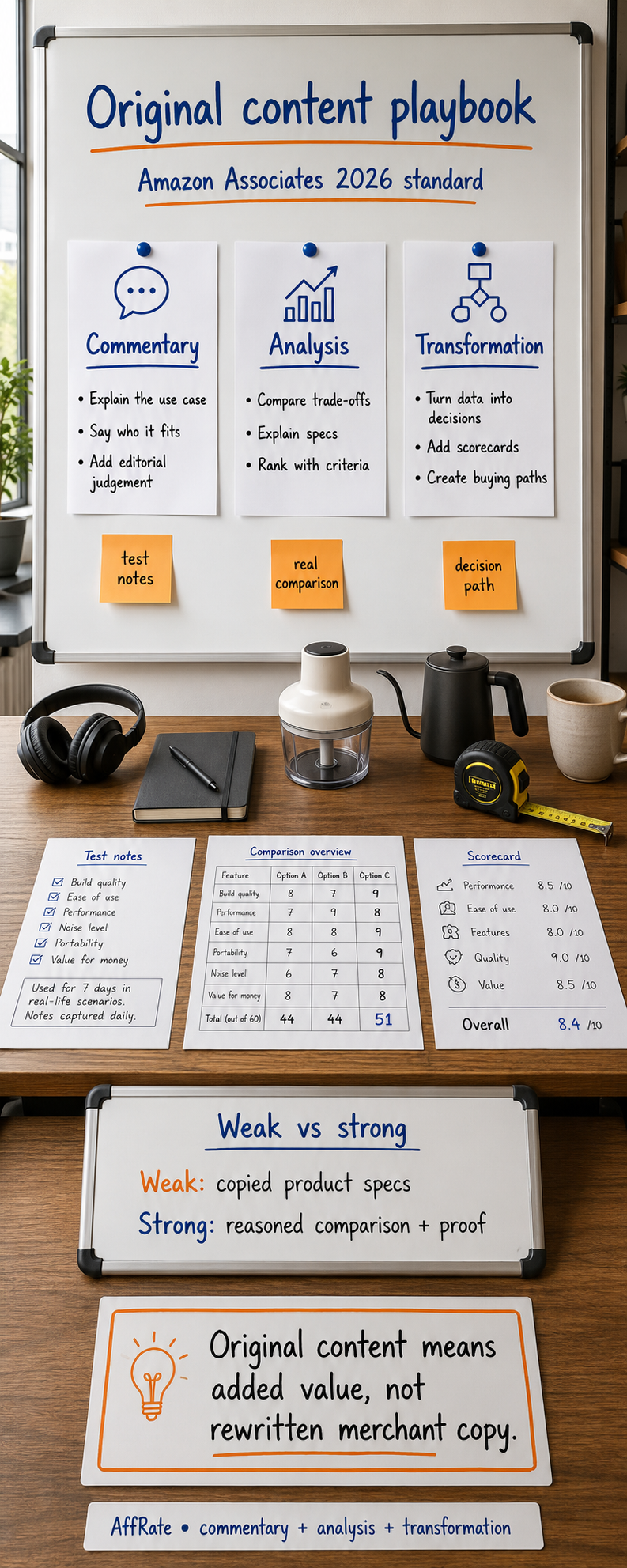
This is the best evergreen angle for affiliate publishers. Amazon’s update says original content must contain commentary, analysis, or transformation for additional value. Consequently, a page that only rearranges specs, product images, and merchant copy is weaker than ever.
What “original content” should look like in practice
For affiliate review sites, original content should answer a user’s decision question. For example, “which product is better for a small apartment?” is stronger than “here are five products with copied feature lists.”
- Commentary: explain why a product fits a specific use case.
- Analysis: compare trade-offs, category context, price bands, durability, warranty, and alternatives.
- Transformation: turn raw product data into a useful framework, ranking, checklist, or buying path.
Weak vs strong affiliate content
| Weak pattern | Stronger replacement |
|---|---|
| “Best Amazon products” with generic blurbs. | Use case-led picks with clear ranking logic and original notes. |
| Copied product specs with no judgement. | Explain what specs mean for real users. |
| Single CTA under every product. | Add comparison context before the CTA. |
| AI-style paraphrased merchant copy. | Add tests, screenshots, photos, scorecards, or editorial decision rules. |
For the broader search-discovery context, read iGaming Affiliate AI Playbook 2026 – Data, SEO.
Onsite commissions: same ASIN variant means more precise content
Amazon’s onsite update is especially important for creators and publishers with Storefront content, videos, photos, Idea Lists, and product detail page placements. The new wording says onsite commission scope applies to Direct Qualifying Purchases of the same ASIN variant as the linked product detail page.
Why this matters for creators
If your content points users to a specific variant, do not assume the whole product family behaves the same way. In contrast, build your content and reporting around the exact product detail page and variant you are recommending.
What to update in your workflow
- Match product captions to the exact variant shown.
- Check whether video thumbnails imply a different color, size, or version than the linked ASIN variant.
- Review Storefront Idea Lists for old products, replaced ASINs, or variant mismatches.
- Monitor onsite Store ID reporting separately from traffic you send directly to Amazon.
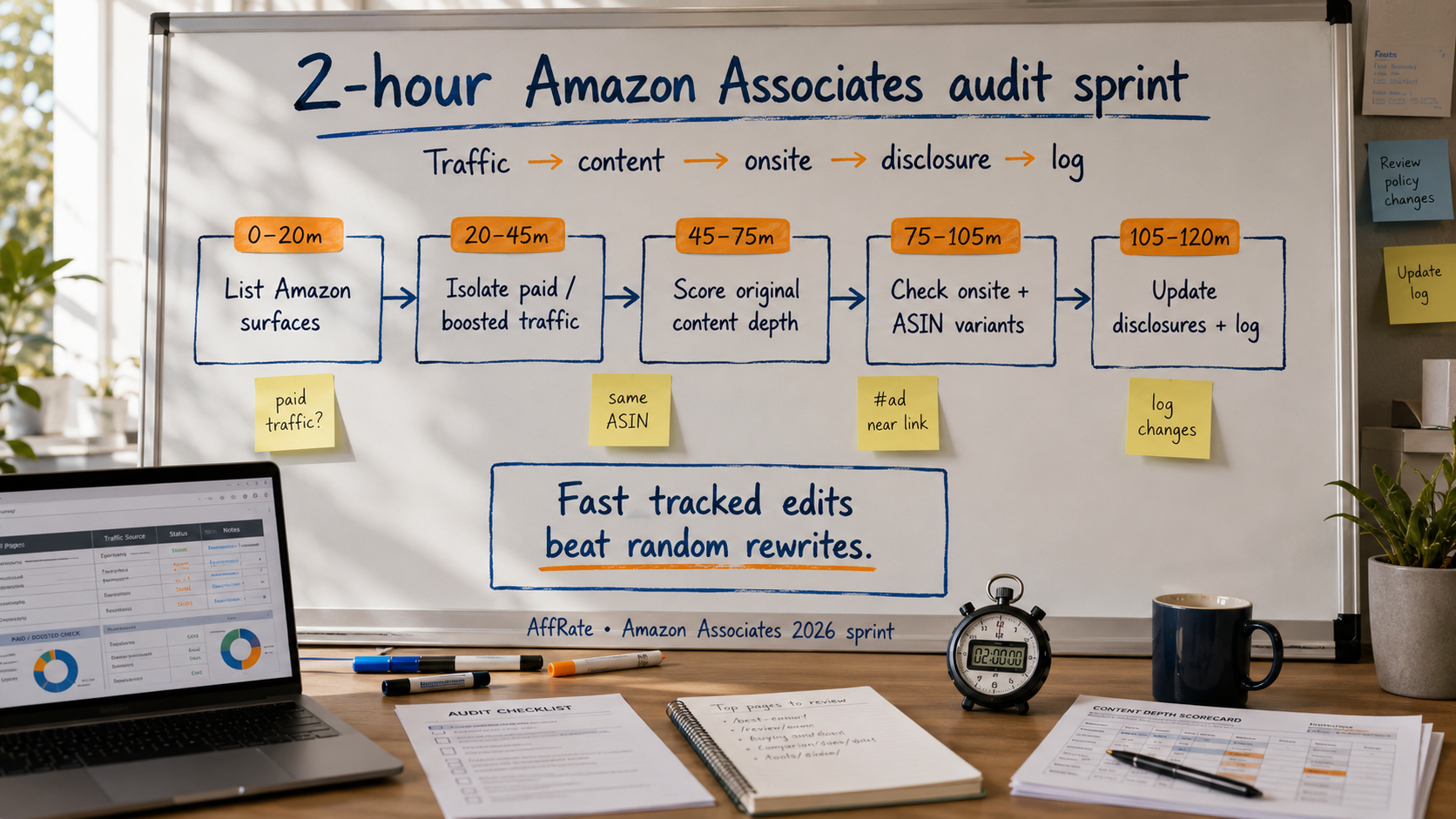
2-hour Amazon Associates 2026 audit sprint
Use this sprint before you rewrite every page. Moreover, keep the edits tracked so you can separate content changes from monetization-template changes.
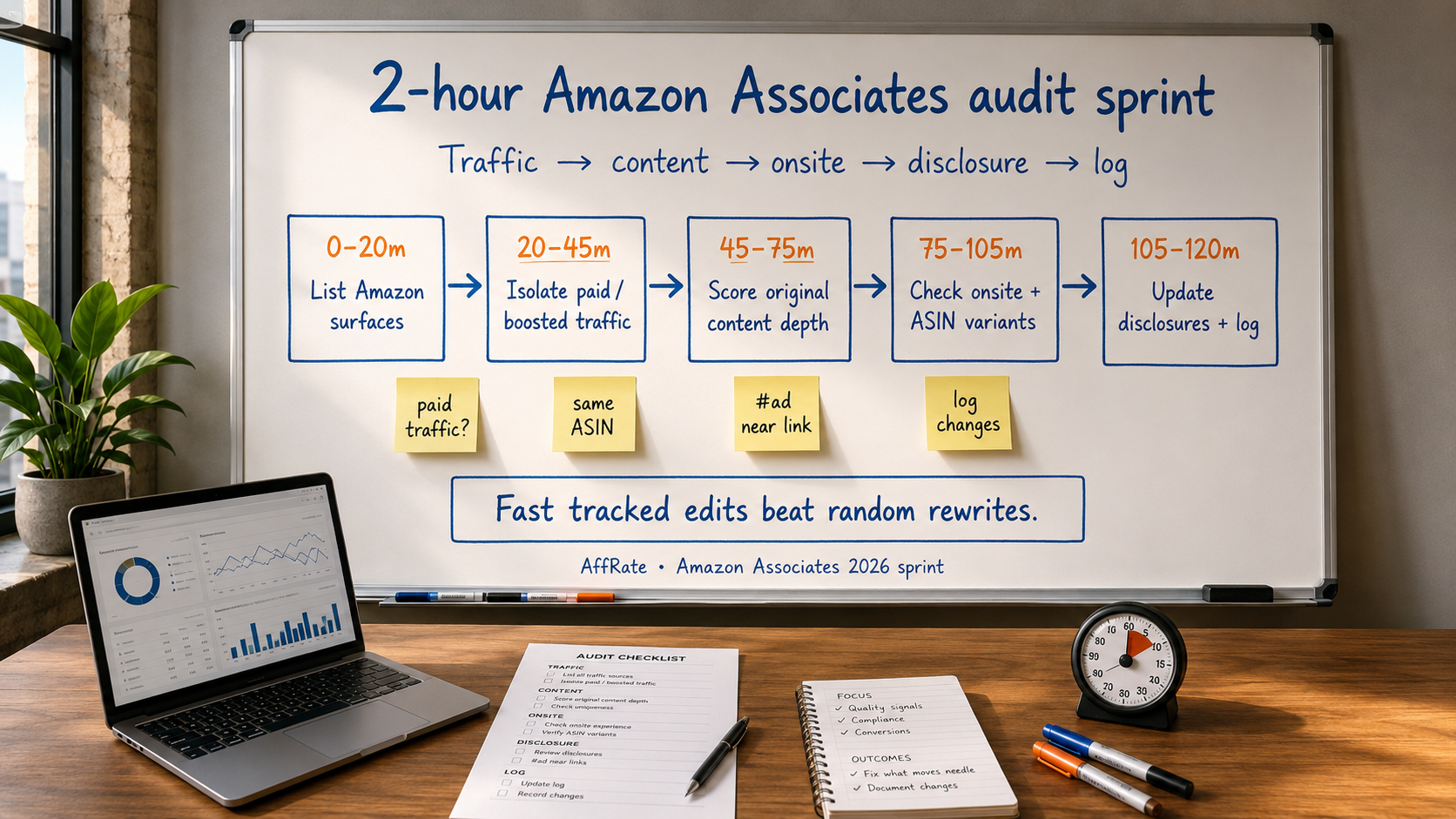
0–20 minutes: list your Amazon surfaces
Start with every channel that can generate Amazon clicks: review pages, comparison pages, gift guides, Storefront content, creator posts, email, paid social, and paid search. Additionally, include third-party placements you boosted or sponsored.
20–45 minutes: isolate paid and boosted traffic
Next, mark any path where a paid or boosted placement links to Amazon. If the path is direct-to-Amazon, flag it for immediate review. If it goes to your own page, check whether the page is real editorial content or just a redirect-like bridge.
45–75 minutes: score original content depth
Now review the top pages by revenue. Add a simple pass/fail note for commentary, analysis, and transformation. If a page fails all three, it should not be treated as a safe long-term Amazon page.
75–105 minutes: check onsite and variant logic
Review videos, Storefront lists, and product recommendations for exact product-detail-page alignment. Meanwhile, remove or update old products that no longer match the current content.
105–120 minutes: update disclosures and publish the log
Finally, make sure the Amazon Associate statement and link-level disclosures are clear and conspicuous. Then add a dated update note.
<!-- AFFRATE AMAZON ASSOCIATES UPDATE LOG -->
<details class="affrate-updates">
  <summary><strong>Update log</strong></summary>
  <ul>
    <li><strong>May 4, 2026:</strong> Audited Amazon paid/boosted traffic paths, original content depth, onsite variant alignment, and disclosure placement after the April 14 Associates update.</li>
  </ul>
</details>
Amazon Associates 2026 checklist for review and comparison pages
This checklist is designed for pages that monetize through Amazon Special Links, product grids, comparison modules, and review CTAs.
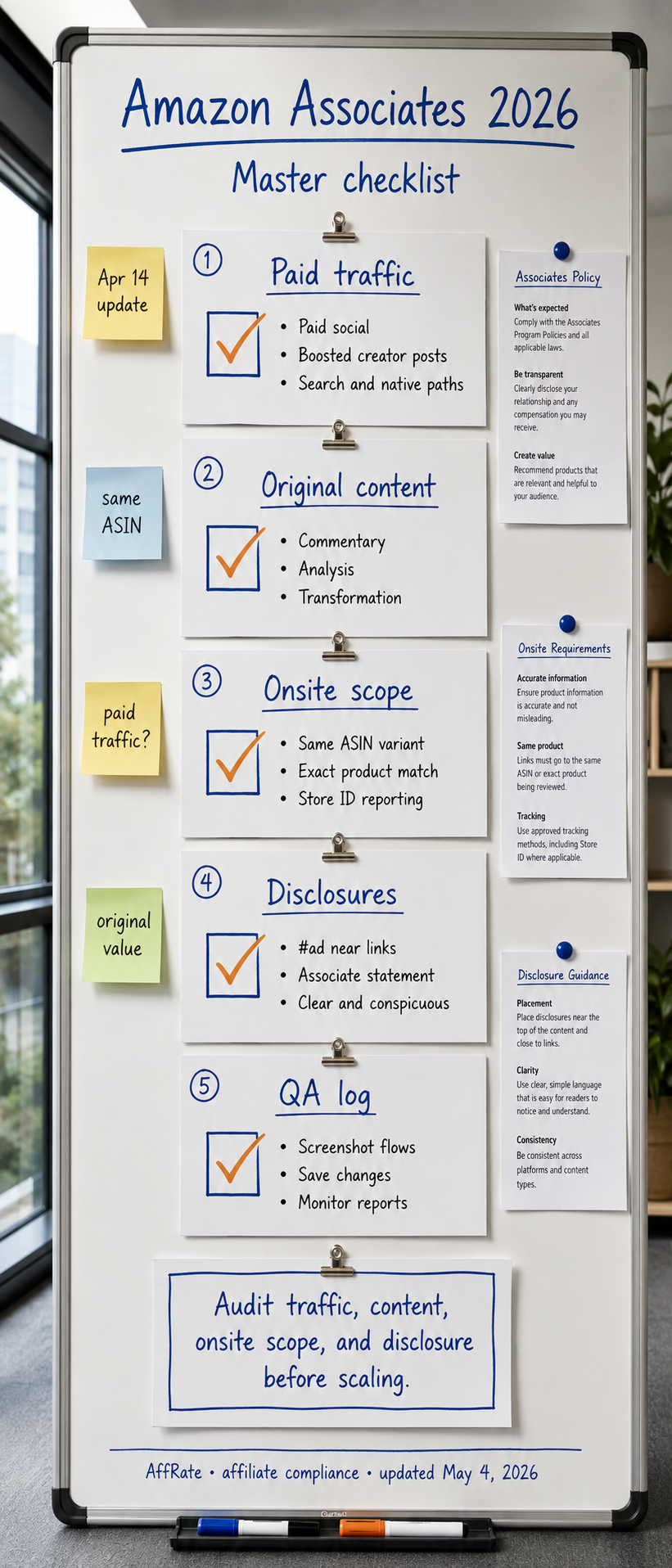
- Paid traffic: are any paid or boosted ads linking directly to Amazon?
- Redirect risk: does a paid ad land on a real editorial page, or does it behave like a bridge to Amazon?
- Original content: does the page include commentary, analysis, or transformation?
- Product lists: when linking to Amazon product-list pages, does your page include additional relevant original content?
- Prices: are price and availability claims sourced correctly and not stale?
- Reviews: are you using Amazon customer reviews or star ratings only through approved API paths?
- Onsite scope: do Storefront videos and Idea Lists align with exact ASIN variants?
- Disclosure: is the link-level disclosure clear and close to the link or review?
- Associate statement: does the required Amazon Associate statement appear clearly on the site?
- Claims: are you avoiding exaggerated, inaccurate, or misleading product claims?
For AffRate’s site-wide disclosure standards, see Advertising & Affiliate Disclosure.
Disclosure template: Amazon Associates 2026 wording
Amazon’s help page says affiliate links should be disclosed clearly and conspicuously, and it gives examples such as “paid link,” “#ad,” or “#CommissionsEarned.” It also says the Operating Agreement requires the Amazon Associate statement to appear clearly and conspicuously on your Site.
Above-the-fold disclosure block
<!-- AFFRATE AMAZON DISCLOSURE BLOCK -->
<aside class="affrate-callout affrate-disclosure" role="note">
  <strong>#ad / affiliate disclosure:</strong> This page may contain Amazon affiliate links.
  As an Amazon Associate I earn from qualifying purchases.
</aside>
Link-level disclosure examples
<!-- LINK-LEVEL DISCLOSURE OPTIONS -->
<p><small>#ad: This product link may earn us a commission.</small></p>

<p><small>Paid link: we may earn from qualifying purchases.</small></p>

<p><small>#CommissionsEarned: affiliate link disclosure.</small></p>
Product-review reminder
<!-- PRODUCT REVIEW SAFETY NOTE -->
<aside class="affrate-callout affrate-review" role="note">
  <strong>Review note:</strong> We use editorial judgement, product research, and comparison criteria.
  Product prices, availability, and terms can change.
</aside>
Compliance & RG: keep AffRate trust signals visible
This Amazon update is not an iGaming rule. However, AffRate’s site-wide trust baseline still applies: clear commercial disclosure, legal-region language, and responsible messaging should stay visible across all affiliate education content.
- #ad disclosure: keep it above the fold when commercial links are present.
- 18+ site baseline: AffRate is an informational resource for adult audiences.
- Responsible gambling: where iGaming content is linked, keep RG language and support resources visible.
- No misleading claims: avoid guarantees, exaggerated earnings claims, or unclear relationship language.
For AffRate’s safer-gambling baseline, see Responsible Gambling. For iGaming disclosure and geo-fencing standards, see Affiliate Compliance 2026 – #ad, RG & Geo‑Fencing.
FAQ: Amazon Associates 2026
When did the Amazon Associates 2026 changes become effective?
Amazon’s “What’s Changed” page says the listed Operating Agreement and Program Policies updates are effective April 14, 2026.
What is the biggest risk for affiliates?
The paid and boosted ad change deserves immediate attention. If a paid or boosted placement links directly to Amazon, review it before scaling.
Does Amazon now require original content?
Amazon’s April 14 update added a definition requiring original content to contain commentary, analysis, or transformation for additional value. Therefore, copied product descriptions and generic listicles are not enough.
What changed for onsite commissions?
Amazon says onsite commission scope now applies only to Direct Qualifying Purchases of the same ASIN variant as the linked product detail page.
What disclosure should Amazon affiliates use?
Amazon says affiliates should include a legally compliant disclosure with links and identify themselves on the site as an Amazon Associate. Its help page states that the required language is: “As an Amazon Associate I earn from qualifying purchases.”
Sources (verified May 4, 2026)
- Amazon Associates — Operating Agreement: What’s Changed (effective April 14, 2026)
- Amazon Associates — Program Policies
- Amazon Associates — Operating Agreement
- Amazon Associates — Why do I have to identify myself as an Associate?
- Amazon Associates — Earning Onsite Commissions
- Amazon Associates — Onsite Associates Program Commission Income Statement
- FTC — Consumer Reviews and Testimonials Rule: Questions and Answers


