


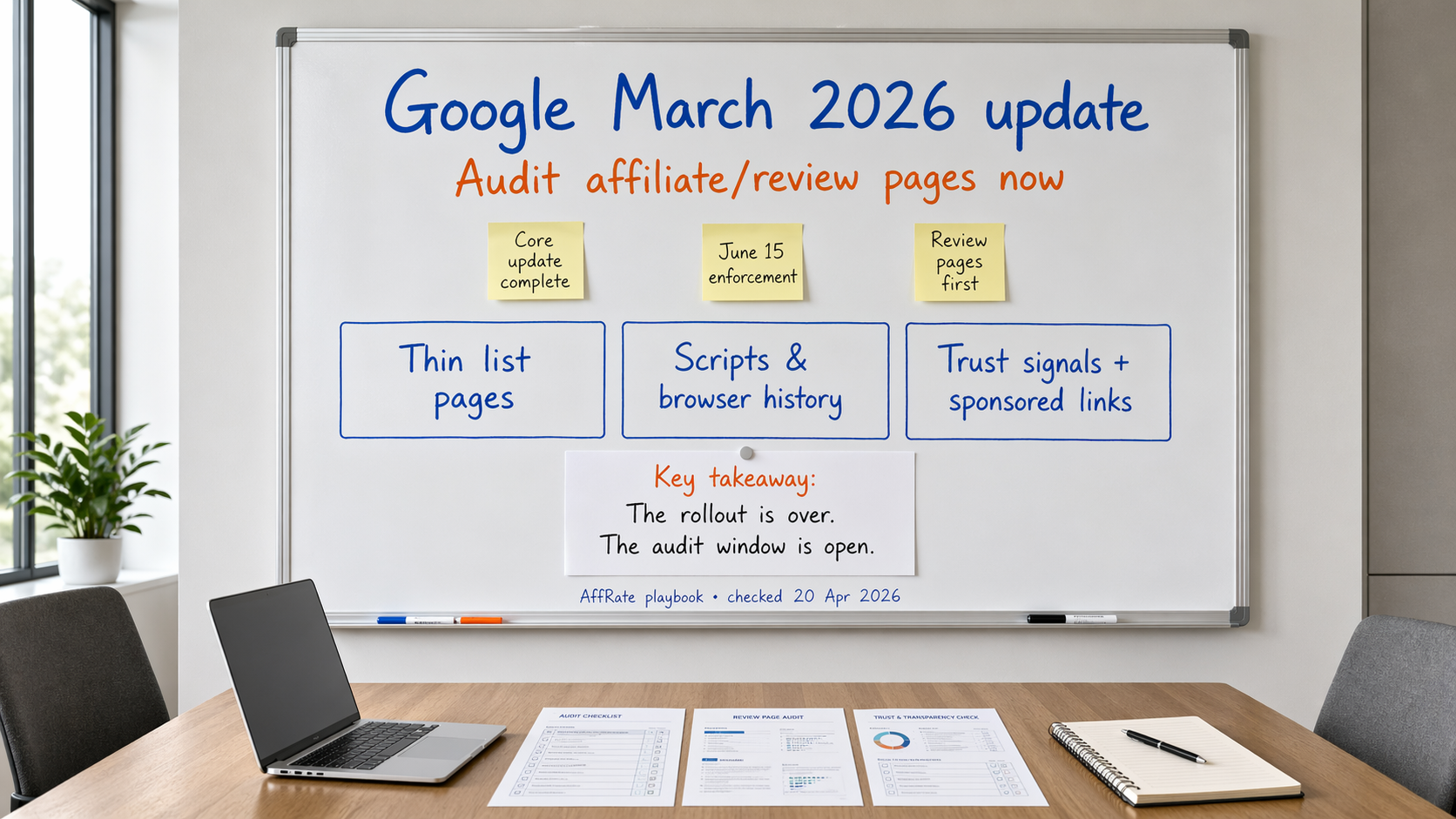
Updated: April 20, 2026 — This is the right week to publish a real audit, not another recap. The March 2026 core update finished on April 8, Google says site owners should wait at least a full week before analyzing Search Console, and the new back button hijacking spam policy now gives affiliate and review sites a live June 15 deadline to clean up scripts and browser-history abuse.
#ad disclosure: This post may contain affiliate links. AffRate is an informational resource, not a gambling operator. 18+ only. Legal/regulated regions only. Offers vary by location. Please play responsibly.
Not legal advice: This is an editorial and SEO operations guide for affiliate and review publishers. Platform behavior, ad stacks, and scripts vary by site, so verify changes in your own environment before shipping them globally.
Google March 2026 update: TL;DR for affiliate sites
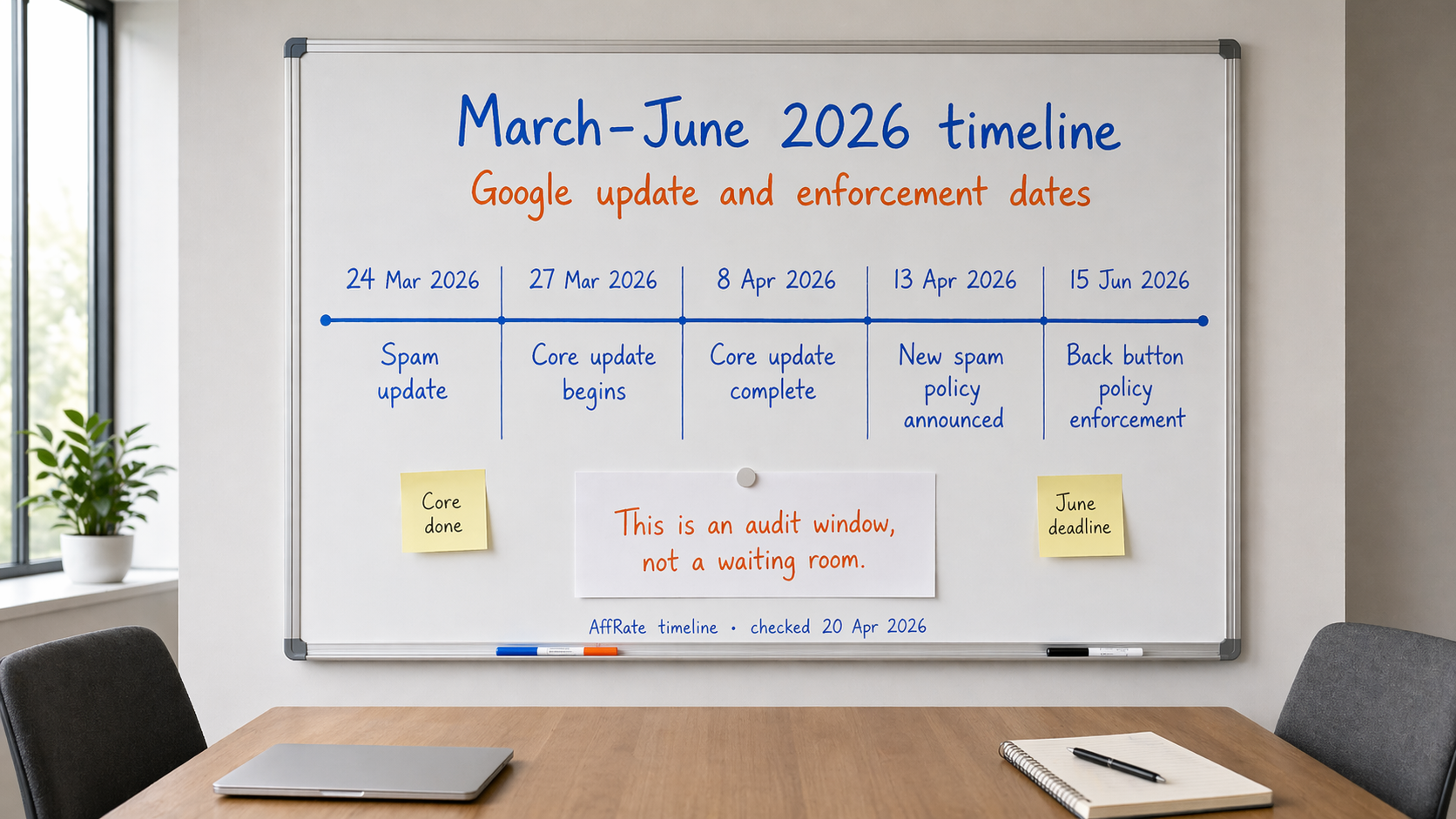
- March 2026 spam update: Google’s Search Status Dashboard logs it on March 24, 2026.
- March 2026 core update: rollout started on March 27, 2026 and finished on April 8, 2026.
- New deadline: on April 13, 2026, Google introduced an explicit spam policy for back button hijacking, with enforcement starting on June 15, 2026.
- What this means for affiliates: this is not the moment for cosmetic “SEO fixes.” Instead, audit thin ranked lists, over-monetized pages, browser-history manipulation, commercial link labeling, author trust signals, and first-hand evidence.
What happened in the Google March 2026 update
There were really three separate things to understand. First, the March 2026 spam update hit on March 24. Then, the March 2026 core update rolled out from March 27 to April 8. Finally, Google published a new spam policy on April 13 targeting back button hijacking, with enforcement beginning June 15.
1) The March 2026 spam update was short, but it matters
Spam updates are not “review site updates” by name. However, they matter for affiliate publishers because they often expose fragile monetization patterns, recycled content clusters, and manipulative page behavior faster than broader quality improvements do.
2) The March 2026 core update is broad by design
Google’s guidance for core updates is still the same: these are broad changes meant to improve overall helpfulness and reliability in search. Therefore, a drop does not automatically mean one page element is “the problem.” In practice, the right response is to reassess your top pages, not panic-edit the entire site.
3) Back button hijacking is now an explicit spam risk
This is the freshest angle, and it is exactly why this topic is strong on April 20. Google says pages that interfere with normal back-button behavior may face manual spam actions or automated demotions, and it specifically notes that some cases can come from included libraries or advertising platforms. That gives this article a second shelf life through June 15.
If you publish list pages or review hubs, compare your evidence standards with our internal scoring philosophy here: Affiliate Portal Scoring Methodology. Additionally, if you want your own portal benchmarked after cleanup, use Submit Your Site.
Google March 2026 update audit: the 6 areas to review first
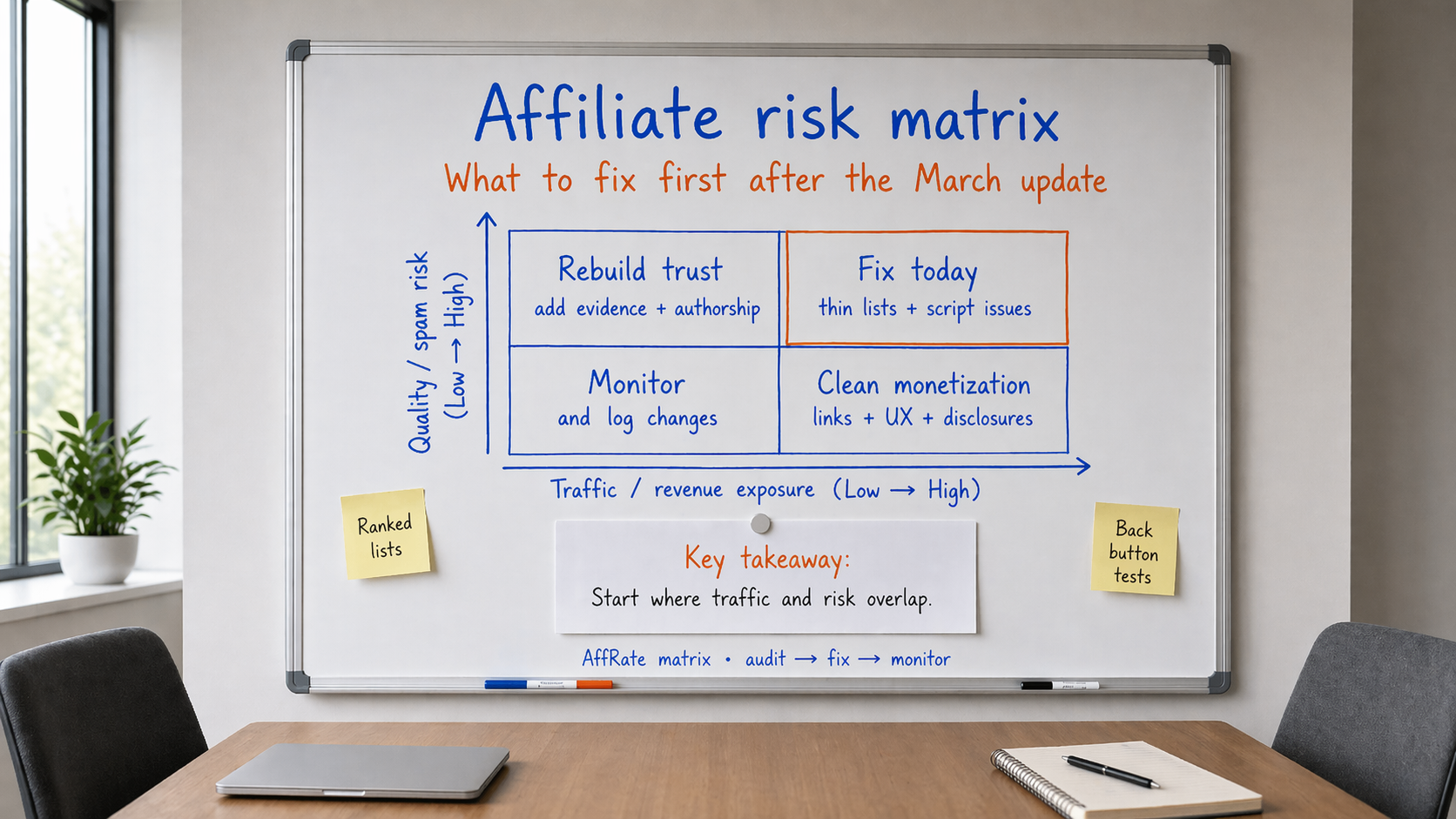
The fastest way to waste this update is to chase a myth. The better move is to audit the surfaces where affiliate and review sites usually get weak: ranked lists, copied merchant copy, commercial links, thin author signals, unstable UX, and script-driven manipulation.
| Audit area | What to inspect | Why it matters | Fast fix |
|---|---|---|---|
| Ranked list depth | “Best” pages with generic intros, shallow item blurbs, and no decision logic. | Google’s reviews guidance explicitly covers ranked lists and says they must stand on their own. | Add original reasoning, scoring logic, comparisons, and first-hand supporting evidence. |
| Thin affiliation | Merchant-fed descriptions, cloned templates, near-duplicate landing pages. | Google’s spam policies say thin affiliate pages are a bad experience when they add no value. | Rewrite or consolidate pages that do not provide meaningful added value. |
| Evidence & experience | No screenshots, no tests, no original measurements, no “why this is best” proof. | Google asks for visuals, original research, quantitative measurements, and first-hand support. | Add test notes, screenshots, comparison tables, and reasoned judgments. |
| Commercial links | Affiliate links without proper qualification. | Google says affiliate links are fine, but asks sites to use rel="sponsored". | Audit outbound CTA modules and update templates. |
| Trust & authorship | Missing author pages, weak sourcing, no editorial process, no update logs. | Google’s people-first guidance leans heavily on evidence, transparency, and trust. | Add author bios, review process notes, source links, and changelogs. |
| Scripts & browser history | Ad scripts, pop-under logic, interstitials, router/history hacks, third-party libraries. | The new spam policy explicitly targets back button hijacking. | Test on mobile and desktop, isolate problem scripts, and remove risky behavior before June 15. |
For the broader AI-search layer, see iGaming Affiliate AI Playbook 2026 – Data, SEO. Meanwhile, for site-wide disclosure and geo logic, use Affiliate Compliance 2026 – #ad, RG & Geo‑Fencing.
Google March 2026 update and back button hijacking: technical checks before June 15
This is where many affiliate teams will miss the story. The policy is not only about obviously shady pages. Google specifically warns that some instances may come from included libraries or advertising platforms. Therefore, your “SEO problem” may actually sit in tag management, monetization scripts, or a routing layer nobody reviewed recently.
What to test this week
- Back-button behavior on mobile: does a user return to the previous page immediately, or get trapped in extra history states?
- Interstitial stacks: are pop-ups or ad layers inserting states into browser history?
- SPA / router logic: are you using
history.pushStateor route replacement in a way that changes expected navigation? - Ad platform scripts: test with and without the ad stack loaded.
- Consent / monetization bundles: cookie banners, engagement widgets, or “continue reading” modules can create side effects.
Affiliate links: fix the markup while you are here
At the same time, use this audit to review how your commercial links are labeled. Google’s current documentation says affiliate links are allowed, but asks publishers to qualify them with rel="sponsored". That is a small change, but it removes ambiguity.
<!-- AFFRATE LINK TEMPLATE (COMMERCIAL / AFFILIATE CTA) -->
<a href="https://partner.example.com/offer"
   rel="sponsored"
   class="affrate-cta">
  View offer
</a>
Do not ship blind
Additionally, record your script inventory before you touch anything. If the issue comes from a third-party import, you want a clean rollback path and a dated change log.
<!-- AFFRATE TECH CHANGE LOG -->
<details class="affrate-updates">
  <summary><strong>Tech / SEO update log</strong></summary>
  <ul>
    <li><strong>Apr 20, 2026:</strong> Audited back-button behavior on top landing pages; removed risky history-manipulation script from mobile offer template; re-tested ad stack and consent flow.</li>
  </ul>
</details>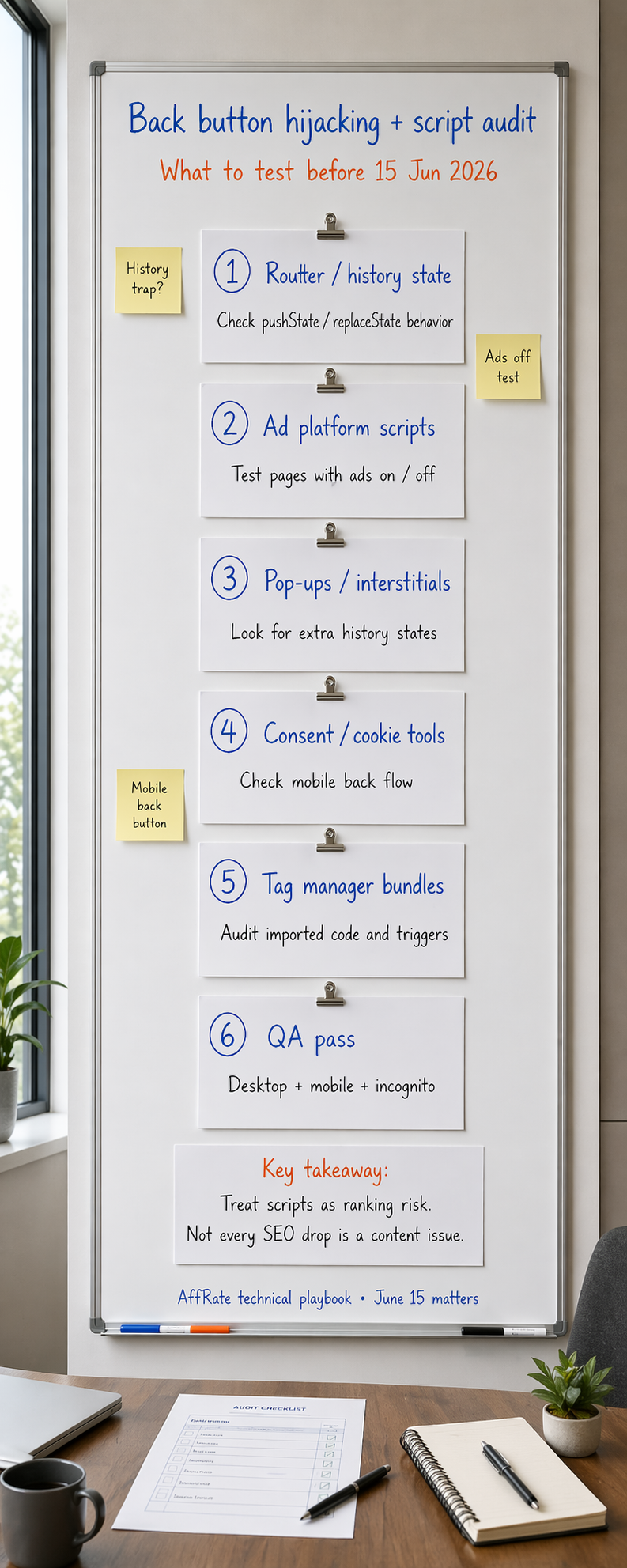
48-hour Google March 2026 update sprint
Because the rollout is over and the waiting week has already passed, you do not need a theoretical workshop. You need a short, disciplined sprint.
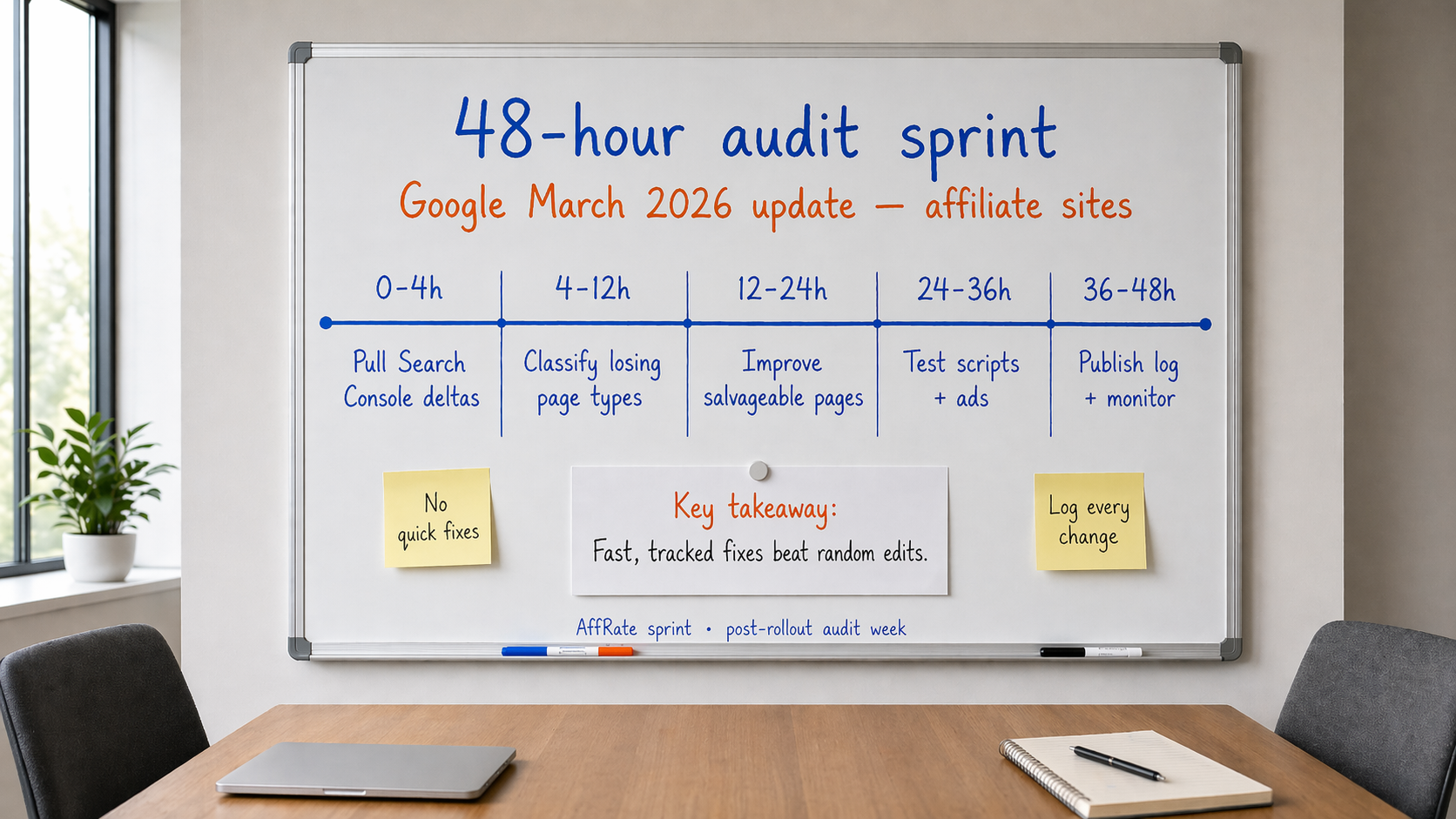
0–4 hours: isolate the impact
Start in Search Console. Compare post-update performance against the pre-update period and isolate your biggest losers by clicks, impressions, and average position. However, do not review the site “in general” first. Review the pages that actually changed.
4–12 hours: classify the losing pages
Next, bucket them into page types. For example: ranked lists, single reviews, comparison pages, bonus hubs, glossary content, or news pages. This matters because a thin list page and a script-broken landing page are not the same problem.
12–24 hours: improve the pages that were already close
Now work on salvageable pages. Add original comparisons, screenshots, first-hand decision criteria, trust notes, and clearer headings. In contrast, pages that are mostly syndicated or templated may need consolidation, not tweaking.
24–36 hours: test scripts and user paths
Load the page with normal scripts, then disable the monetization stack and re-test. As a result, you can quickly tell whether the issue is content quality, technical experience, or both.
36–48 hours: publish, log, and monitor
Finally, ship the changes, log them, and watch only the pages you edited. Moreover, avoid making ten more untracked edits that blur the signal.
Google March 2026 update checklist for affiliate/review sites
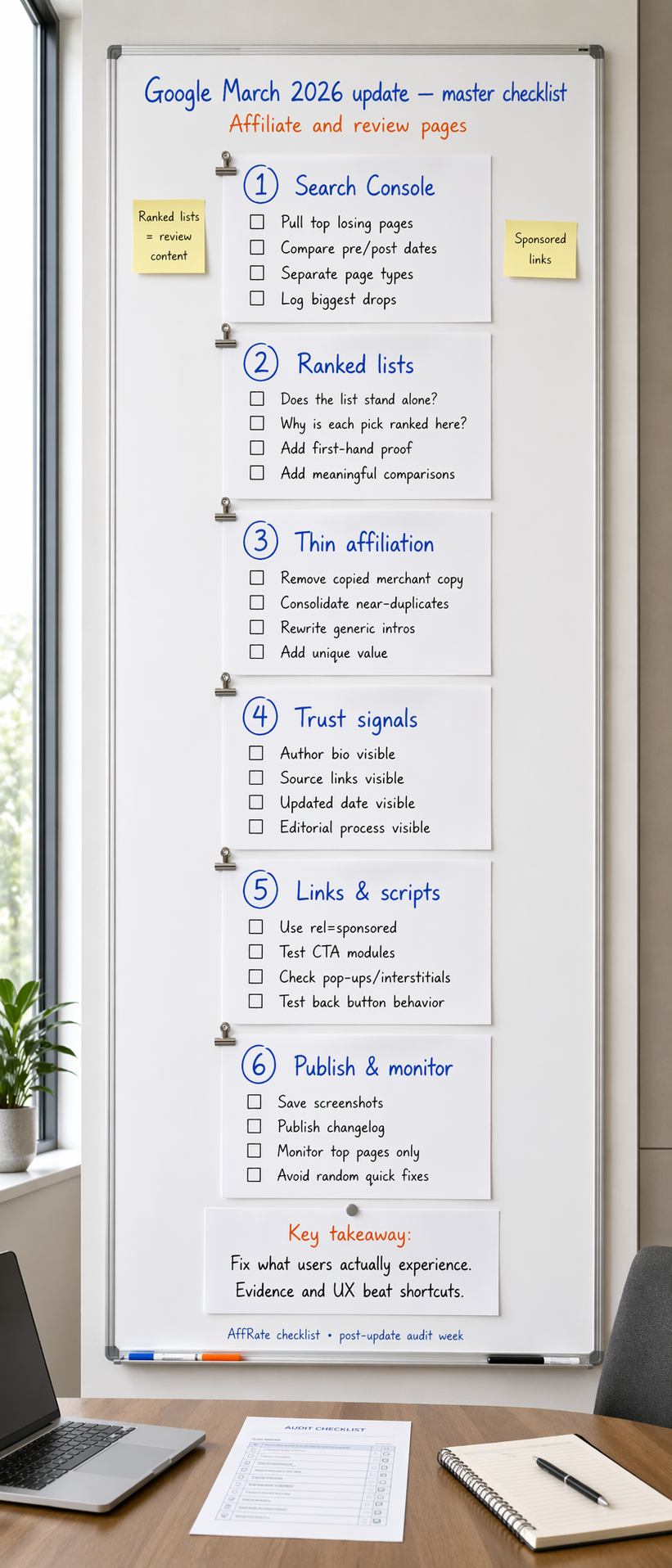
Use this checklist on every important review or list page before you call the audit “done.”
- Ranked lists: do they stand on their own without forcing users into separate single reviews?
- Best picks: do you explain why something is best, with first-hand supporting evidence?
- Comparisons: do you help users choose between realistic alternatives?
- Originality: did you add real analysis, measurements, or experience instead of rewriting merchant copy?
- Commercial links: are affiliate CTAs labeled correctly?
- Authorship: do users see who wrote or reviewed the page?
- Trust: do you show update dates, source links, and editorial standards?
- Scripts: can users back out of the page normally on mobile and desktop?
- Ads: do monetization layers interrupt navigation or create history traps?
- Cleanup discipline: did you keep a dated change log?
If your portal needs a cleaner benchmark after the audit, compare it against the current Affiliates Directory and our 0–100 scoring methodology.
Compliance & RG: keep trust signals visible during a Google March 2026 update audit
It is common to “fix SEO” by removing friction. However, for iGaming and other sensitive affiliate verticals, that can become a trust problem quickly. Do not strip out the signals that help readers understand what the page is, how monetization works, and whether the content is intended for their jurisdiction.
- #ad disclosure: keep it above the fold on commercial pages.
- 18+ messaging: keep age and legal-region language visible.
- Responsible gambling: keep the RG reminder and resource link present.
- Legal-only targeting: do not “recover traffic” by loosening geo logic.
For AffRate’s publishing baseline, see Responsible Gambling and Affiliate Compliance 2026.
FAQ: Google March 2026 update for affiliate sites
Is the March 2026 core update still rolling out?
No. Google’s Search Status Dashboard says the rollout completed on April 8, 2026.
Should I start auditing on April 20, 2026?
Yes. Google recommends waiting at least a full week after the update completes before analyzing Search Console. That waiting period has already passed.
Are ranked lists treated like review content?
Yes. Google’s reviews system explicitly says reviews can be ranked lists of recommendations, and its review guidance says ranked lists should contain enough useful content to stand on their own.
Do affiliate links themselves cause ranking drops?
Not automatically. Google says affiliate links are a common monetization method and are fine in general, but asks publishers to qualify those links appropriately and to provide substantial added value.
What is the highest-priority technical risk right now?
Back button hijacking. Google has now made that an explicit spam-policy issue, with enforcement starting June 15, 2026.
Sources (verified April 20, 2026)
- Google Search Status Dashboard — March 2026 core update
- Google Search Status Dashboard — Ranking incidents history (includes March 2026 spam update)
- Google Search Central Blog — Introducing a new spam policy for “back button hijacking”
- Google Search Central — Google Search’s core updates
- Google Search Central — Google Search’s reviews system
- Google Search Central — Write high quality reviews
- Google Search Central — Creating helpful, reliable, people-first content
- Google Search Central — Spam policies for Google Web Search
- Google Search Central — Qualify your outbound links to Google


