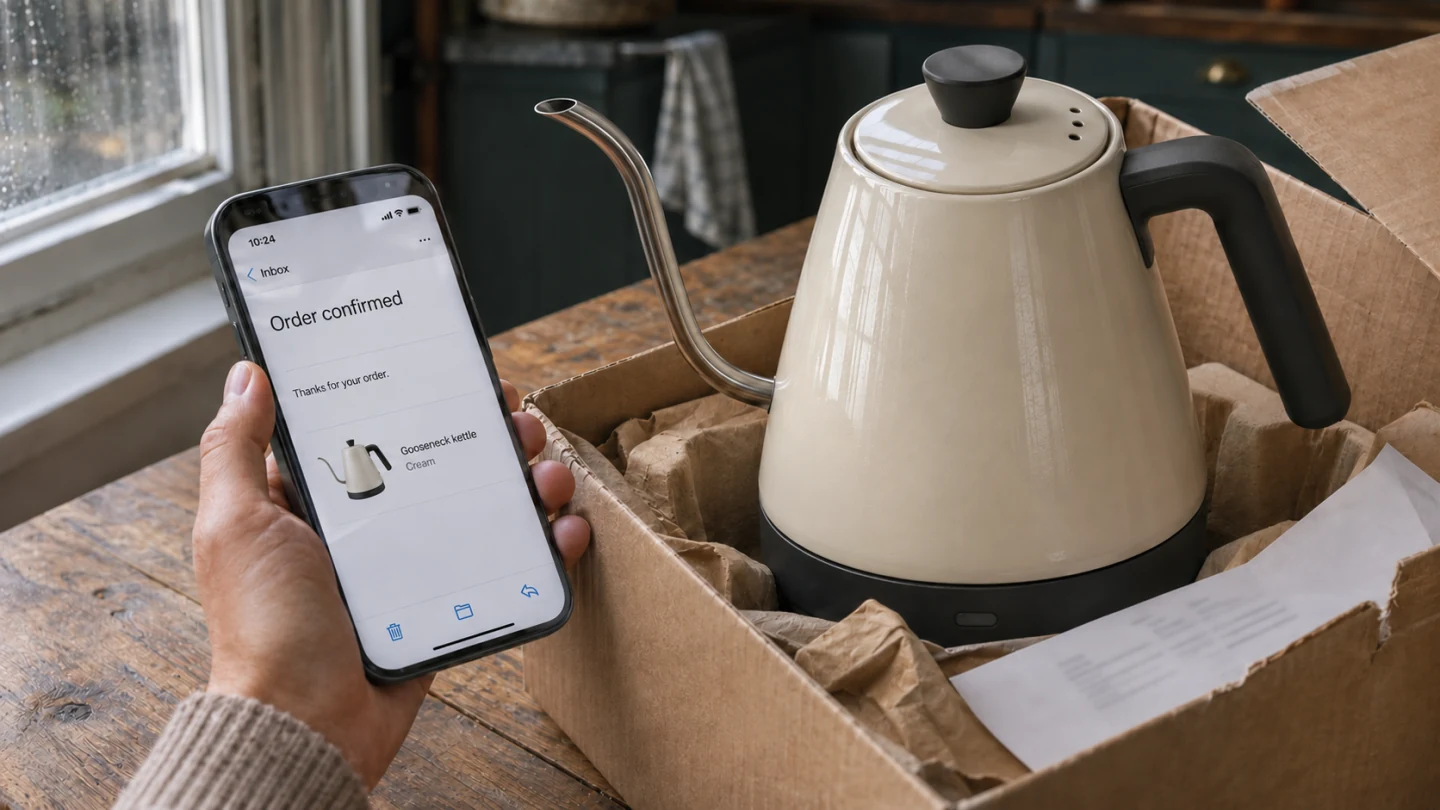

Imagine a reader who spots a cream-colored kettle in your Black Friday gift guide. She taps your Walmart affiliate link on her phone. That evening, she asks Meta’s Muse to find the same model and buys it in the chat. In this hypothetical, you know the guide helped her choose. How would you tell whether the sale earned you a commission?
A recorded click tells you someone followed your link. A payment approval gives an agent permission to place an order. For the answer about your commission, look in the affiliate program’s transaction report. That’s where you can see whether the program connected a qualifying sale to your account.
In its November 19 forecast for Cyber Week 2026, Salesforce said AI and agents would influence $75.8 billion in global online sales from November 24 through 30, about 21% of the $357 billion it projected. A shopper can ask a chatbot whether the kettle fits on her shelf and still place the order herself. Unattended purchases and publisher commissions have no separate totals in Salesforce’s Cyber Week forecast.
Follow the kettle link into Walmart
Walmart calls the link its program supplies a “Qualifying Link.” It identifies your site and takes the reader directly to Walmart’s website or app. Some networks also let you label where a link appears. A gift guide and a newsletter can point to the same kettle and still show up separately in a click report, as in this example of affiliate sub IDs on Awin.
On November 24, Walmart said Meta’s Muse could send a shopping list to its Agent Gateway, where Walmart finds matching products. The first time she adds an item, the shopper signs in to Walmart and sets a spending limit in her Walmart Agent Profile. She can then buy the kettle in the conversation with a card saved to her Walmart account. That’s the route in Walmart’s guide to shopping in Muse.
Does opening Muse count as a direct return to Walmart? Its affiliate agreement requires a qualifying link, a browser with cookies enabled and a qualifying product ordered through Walmart’s system, delivered and paid for. If the customer returns during the applicable referral window, the agreement specifies direct re-entry without another affiliate link. Whether the guide keeps credit for a later purchase in Muse remains open in both the announcement and sections 2 and 5 of Walmart’s affiliate agreement.
What the shopper approves in ChatGPT Wallet
Picture the reader asking a different assistant to buy the kettle. On November 13, ChatGPT Wallet began rolling out through OpenAI’s agents called dots, initially for U.S. ChatGPT Pro subscribers aged 18 and over with eligible U.S.-issued cards. The shopper reviews the item, total and card, then approves with a security check. The payment network supplies a token that stands in for the card details. The agent can submit payment without seeing the actual card number, as OpenAI’s launch announcement explains.
Could she ask it to buy the kettle while she sleeps if the price drops? OpenAI described fully delegated buying within spending limits as a future feature. The launch flow asks for approval on each purchase, though the terms already allow for advance authorization. The issuer decides whether to authorize the charge and the merchant whether to accept the order under the ChatGPT Wallet terms.
Where did checkout actually happen?
Google’s Universal Cart began rolling out in the U.S. across Search and the Gemini app on October 15. The reader could save the kettle there, then pay in the cart with Google Pay at a participating merchant or transfer it to the merchant’s cart to finish on its site. Both routes appear in Google’s Universal Cart announcement.
Suppose another store sells the kettle using Shopify’s checkout on Meta. Google Analytics and custom tracking pixels that run in the shopper’s browser do not fire there. Events that mark a checkout starting or completing still travel directly between servers. A store could have a completed order with no matching browser event. Shopify documents this behavior for its own checkout on Meta.
Can you match the kettle order to your guide?
A click one morning and a sale that evening are a weak match by themselves. Look for a sale credited to your account and an order reference you can match, if available. Walmart names Impact Radius as its reporting platform in its affiliate FAQ. Check the sale’s status, too. A pending sale can still be reversed if the shopper returns the kettle, as the network explains in its guide to partner payments.
Try it with two sample report entries. At 9:12 a.m., your click report shows a referral labeled gift-guide. At 6:47 p.m., your transaction report shows one pending sale with the same placement label. You can count one pending sale for the guide. To say that this reader bought this kettle through Muse, you would need a record that links that order to the checkout channel. A shared placement label alone can’t tell you that.
If the morning click is all you can tie to your guide, count the referral and leave the kettle sale unconfirmed. Ask the program whether a Muse order can be matched to that earlier click and where the credit would appear in your report.
Sources checked November 27, 2026.