

Adobe expects affiliates and partners to receive credit for a larger share of U.S. online sales this holiday season. We read the forecast’s “up 12%” as growth relative to the channel’s starting share of retail revenue. A publisher deciding whether to give a gift guide or a cashback offer more prominence faces a narrower question. Which placement earns more commission per click at a given retailer?
Where cashback and creators fit
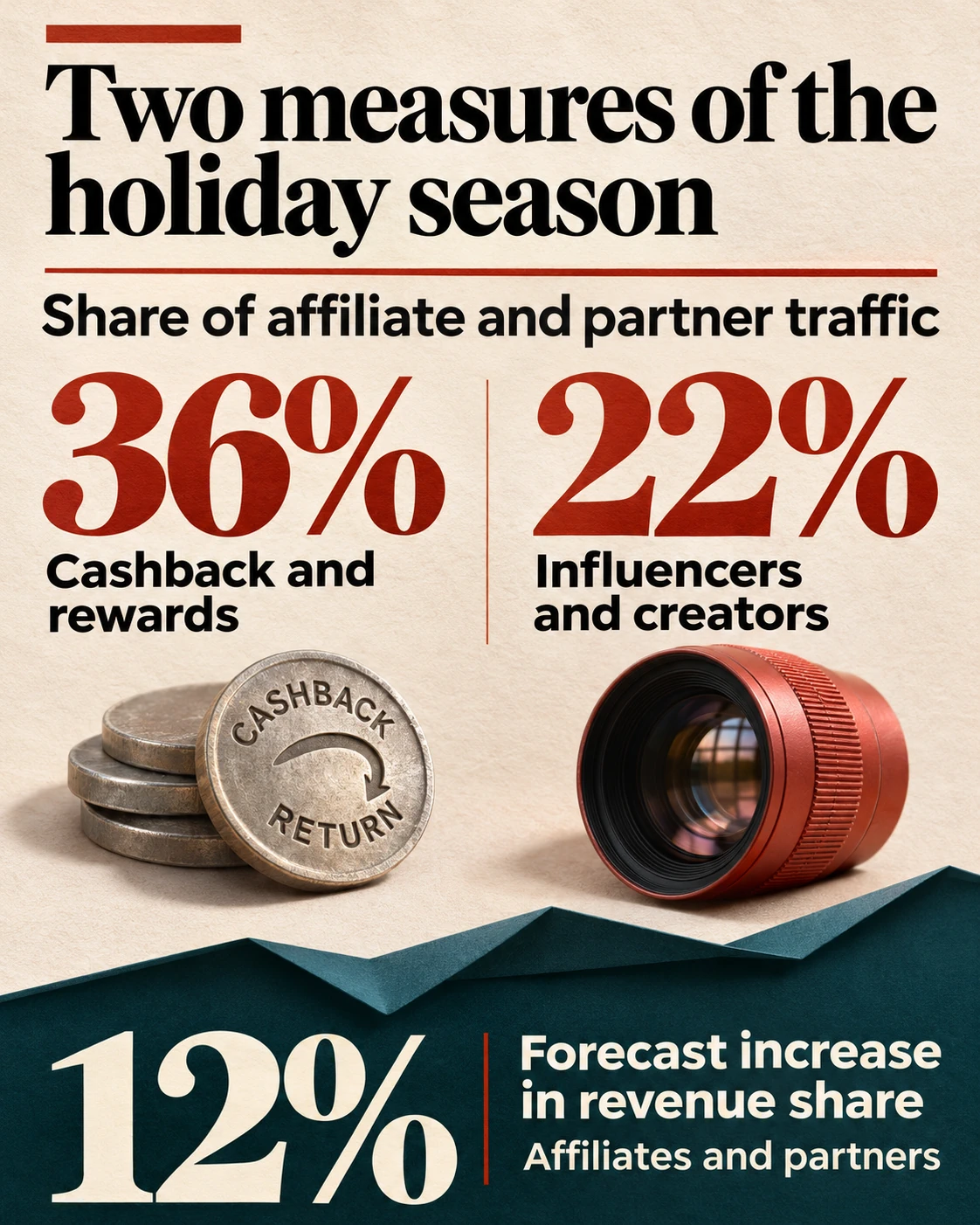
In its September 28 forecast for November 1 through December 31, 2026, Adobe describes the traffic retailers receive from affiliates and partners. Of that traffic, 36% comes from cashback and rewards partners and 22% from influencers and creators. The release leaves the measurement dates for this traffic split unspecified.
A shopper might follow a creator’s video link to look at a gift on Tuesday, then return to the store through a cashback site on Friday. If the shopper buys the gift, the retailer has two visits and one order. How a merchant credits the eventual order depends on its referral rules. The traffic split alone tells us neither which visit prompted the purchase nor how much either publisher earned.
A retailer comparing orders per visit would need each group’s credited orders and the number of visits that group sent. Creators could send fewer visits yet earn credit for more orders if enough of their visitors buy. And a group that produces fewer orders could still account for more retail revenue if those orders are larger. The traffic ranking leaves both possibilities open.
How a 12% gain changes a revenue share
For the revenue forecast, Adobe switches from counting visits to measuring the portion of retail sales attributed to a channel. Consider a hypothetical retailer that previously credited 10% of its online sales to partners. If that share rose by 12%, it would reach 11.2% (10% × 1.12). The change would be 1.2 percentage points.
Adobe also forecasts US$275.1 billion in online holiday spending. Multiplying that total by 12% would mistake the growth rate for the share itself. To estimate the dollar value of partner-attributed sales, a reader would need the channel’s starting or ending share. Adobe gives neither in its release. Even with that figure, the dollars would represent sales at retailers. Each publisher’s commission depends on the orders credited to it and the merchant’s terms.
What two placements earn at the same retailer
For a publisher comparing a gift guide with a cashback placement, start with one merchant and one week of outbound clicks. Match each placement’s clicks to the orders the merchant credits to them. Allow time for its referral window and order review. Use the same currency and reporting cutoff for both placements, and show pending amounts separately.
In a hypothetical week, the gift guide sent 500 clicks and the cashback placement sent 1,000 to the same retailer. After reviewing the orders it attributed to those clicks, the retailer approved US$90 in commission for the guide and US$120 for cashback. Cashback brought in US$30 more commission overall. Dividing by the clicks each sent puts the guide at US$0.18 per click (US$90 ÷ 500) and cashback at US$0.12 (US$120 ÷ 1,000).
The choice depends on what the editor can change. If either placement could send the next 100 clicks and each kept its observed yield, the guide would earn US$18 and cashback US$12. A more prominent slot could attract a different set of readers, changing that yield. The comparison also stops at commission. If the publisher funds the cashback reward, the amount passed to shoppers is a cost to deduct before comparing margins.
Those numbers tell the editor which placement earned more per click at one retailer under its attribution rules. If the retailer credits only the final referral, the cashback placement could earn commission on an order the gift guide helped a reader discover. Estimating how many sales would disappear without the guide would take a separate comparison. The merchant’s commission report alone cannot settle that question.
Sources checked November 20, 2026.


