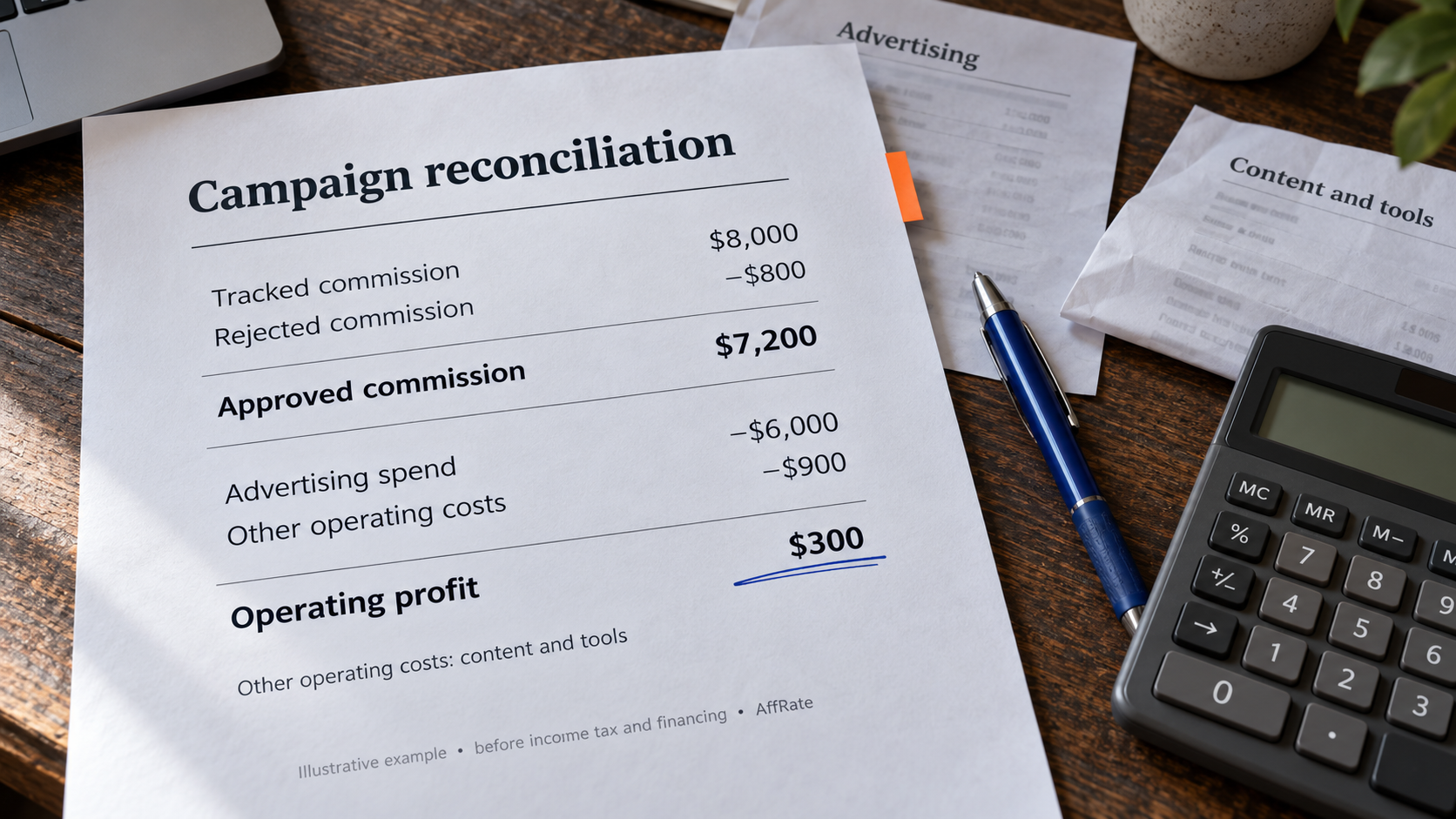
Updated: October 27, 2026 — An affiliate dashboard can show $8,000 in tracked commission while the campaign keeps only $300 after approvals and costs. The worked example below shows how. This affiliate marketing ROI guide explains which revenue to count, which costs to include, and why a high EPC can still hide a weak campaign.
#ad / affiliate disclosure: AffRate labels commercial placements and affiliate links. Links in this guide are source references, not tracked offers. For iGaming content: 18+ or the higher local legal age, licensed markets only. Gamble responsibly.
Affiliate marketing ROI: the formula that matters
Start with the commission you can reasonably count for the reporting period or customer cohort. Then subtract the costs assigned to that same period or cohort.
Campaign operating profit =
Approved commission after adjustments − Total campaign costs

Affiliate marketing ROI (%) =
Campaign operating profit ÷ Total campaign costs × 100
In this guide, approved commission excludes rejected actions and unresolved pending amounts. If a later adjustment changes the commission, update the calculation.
Total costs include media spend, content, staff or contractor time, tools, hosting, creative work and any payment or currency fees that apply. Allocate shared costs using a consistent method.
ROI, ROAS and profit margin are different
| Metric | Formula used here | Question it answers |
|---|---|---|
| Operating profit | Approved commission − all assigned campaign costs | How much remains after the costs in this model? |
| ROI | Operating profit ÷ all assigned campaign costs | What return did those costs produce? |
| ROAS | Attributed approved commission ÷ advertising spend | How much commission did each advertising dollar generate? |
| Operating margin | Operating profit ÷ approved commission | What share of commission remains as operating profit? |
A ROAS above 1 does not prove profitability. It does not include every cost. And gross customer sales or player deposits are not affiliate revenue: the affiliate earns the commission defined by the agreement.
Affiliate profit example: 10,000 paid clicks
Consider one hypothetical acquisition cohort. It generates 10,000 paid ad clicks and 4,000 outbound affiliate clicks. The partner records 160 potentially qualifying actions at a $50 CPA.
After validation, 144 actions qualify and 16 are rejected. Nothing remains pending in this example.
| Item | Calculation | Result |
|---|---|---|
| Paid ad clicks | Assumption | 10,000 |
| Outbound affiliate clicks | Assumption | 4,000 |
| Provisional tracked commission | 160 × $50 | $8,000 |
| Rejected commission | 16 × $50 | −$800 |
| Approved commission | 144 × $50 | $7,200 |
| Advertising spend | 10,000 × $0.60 | $6,000 |
| Content and editorial work | Assigned campaign cost | $600 |
| Tracking, tools and hosting | Assigned campaign cost | $300 |
| Total costs | $6,000 + $600 + $300 | $6,900 |
| Operating profit | $7,200 − $6,900 | $300 |
| Affiliate marketing ROI | $300 ÷ $6,900 × 100 | 4.3% |
Other operating costs are assumed to be zero in this simplified example. A real campaign must include any additional costs rather than quietly leaving them out.
The campaign has a 1.20× ROAS and a 4.2% operating margin. Neither number means the same thing as its 4.3% ROI.
For the wider discussion of commission models and traffic economics, read our Affiliate Profit Analysis: EPC, CPA vs Rev-Share and Risk. This guide focuses on the calculation behind those decisions.
EPC vs CPC: use the same click denominator
This is an easy mistake to miss. Your affiliate dashboard may calculate earnings using outbound affiliate clicks. Your advertising platform charges for clicks that bring people to your website.
Those are not necessarily the same clicks.
Two valid figures, two different meanings
In our example:
Approved EPC per outbound affiliate click =
$7,200 ÷ 4,000 = $1.80

Approved revenue per paid ad click =
$7,200 ÷ 10,000 = $0.72

Paid CPC =
$6,000 ÷ 10,000 = $0.60
Comparing $1.80 directly with $0.60 exaggerates the available margin. The comparable revenue figure is $0.72 per paid click.
That leaves $0.12 per paid click before non-media costs. Across 10,000 clicks, it produces $1,200. Subtract the remaining $900 of costs, and the campaign keeps $300.

Check whether EPC means one click or 100 clicks
Awin’s affiliate marketing glossary describes EPC as total commission divided by clicks. FlexOffers defines its EPC per 100 clicks.
An EPC of $180 per 100 clicks equals $1.80 per click. It does not mean $180 for each visitor.
Before comparing programmes, check the unit, reporting window, commission status, country mix and traffic source. Also confirm whether the figure describes your own account or the wider programme.
How to calculate break-even CPC
Break-even CPC is the maximum average cost per paid click that leaves zero operating profit under your assumptions.
Break-even paid CPC =
(Approved commission − Non-media costs) ÷ Paid ad clicks
For the example:
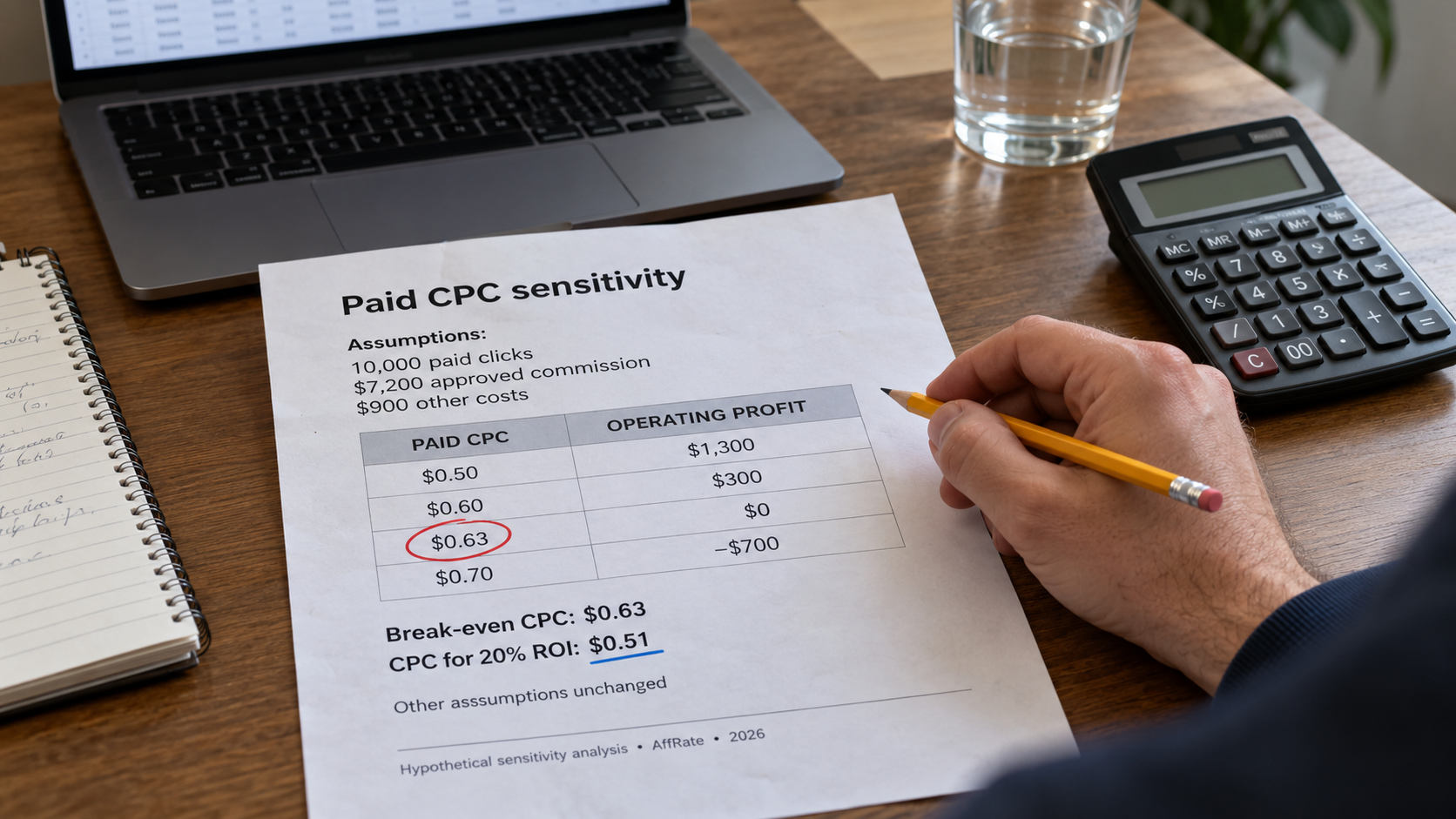
($7,200 − $900) ÷ 10,000 = $0.63The campaign can afford $0.63 per paid click only if commission, click volume and non-media costs stay unchanged. That is a break-even point, not a target with room for error.
| Average paid CPC | Media spend | Total costs | Operating profit | ROI |
|---|---|---|---|---|
| $0.50 | $5,000 | $5,900 | $1,300 | 22.0% |
| $0.60 | $6,000 | $6,900 | $300 | 4.3% |
| $0.63 | $6,300 | $7,200 | $0 | 0.0% |
| $0.70 | $7,000 | $7,900 | −$700 | −8.9% |
Set a target return, not just a survival point
Suppose your planning target is a 20% return on total campaign costs. This is an example target, not an industry recommendation.
Maximum paid CPC for target ROI =
[Approved commission ÷ (1 + Target ROI) − Non-media costs]
÷ Paid ad clicks

For a 20% target:
[$7,200 ÷ 1.20 − $900] ÷ 10,000 = $0.51
Under these assumptions, $0.51 is the cost ceiling for a 20% ROI. In practice, cheaper traffic may convert differently, so changing bids does not guarantee the same revenue.
CPA vs rev-share vs hybrid: compare the same cohort
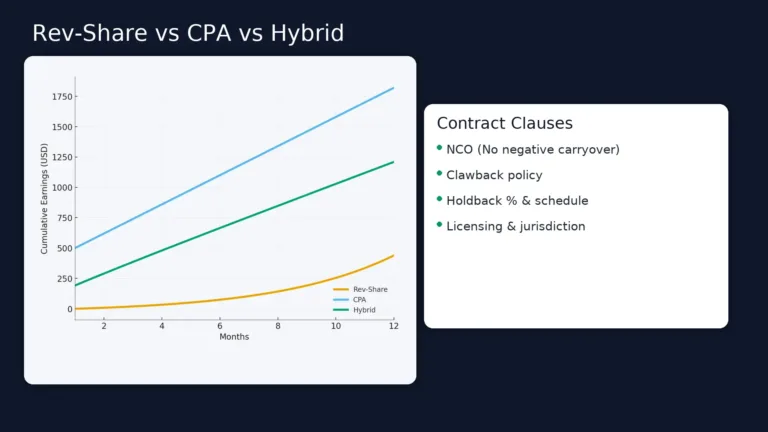
A monthly CPA payment and a lifetime revenue-share forecast are not a fair comparison. Choose one acquisition cohort and compare cumulative commission over the same period.
For the next example, assume the same 144 qualifying customers under each hypothetical agreement. Their cumulative contract-eligible net revenue is $12,000 after 30 days and $30,000 after 90 days.
These net revenue figures and commission rates are invented for the calculation. They are not quoted offers or expected customer values.
| Model | Assumed deal | After 30 days | After 90 days |
|---|---|---|---|
| CPA | $50 × 144 qualifying customers | $7,200 | $7,200 |
| Revenue share | 30% of eligible net revenue | $3,600 | $9,000 |
| Hybrid | $20 × 144 customers + 15% of eligible net revenue | $4,680 | $7,380 |
The 90-day figures already include the first 30 days. Do not add the columns together.
CPA leads in the first month of this example. Revenue share leads after 90 days because of the assumed net revenue growth. Different retention, deductions or customer results could reverse that outcome.
These are commissions, not profits. To calculate 90-day ROI, subtract all costs assigned to the cohort through day 90, including any additional servicing and content costs.

Read the revenue base before comparing percentages
A percentage is incomplete without its contract definition. For example, the bet365 Partner Programme ROW terms (version dated April 1, 2026) list deductions from Net Revenue, including winnings, certain taxes, chargebacks, rewards and administrative costs. They also describe offsetting negative commission balances against available commissions.
That is one programme’s contract, not a universal formula. Check your own agreement for qualifying actions, deductions, negative carryover, cross-product offsets, payment thresholds and termination terms.
Do not subtract an operator deduction twice: once inside the reported commission base and again as your own expense.
Approved commission is not cash in the bank
impact.com’s payment guide distinguishes pending actions, locked actions and payout processing. A tracked action can still be awaiting validation. A locked amount can still be waiting for payment.
Keep three separate totals in your own report: provisional commission, approved unpaid commission and money received.
A profitable campaign can still need working capital
Return to the $7,200 approved-commission example. Suppose all $6,900 of costs have been paid, but only $5,000 of the commission has reached your bank.
Approved-basis operating profit:
$7,200 − $6,900 = $300

Campaign cash movement so far:
$5,000 − $6,900 = −$1,900

Approved commission still unpaid:
$7,200 − $5,000 = $2,200
The campaign has a positive modelled profit and a negative cash position at that date. Payment timing explains the difference; it does not automatically mean the unpaid balance is bad debt.
Use a cash schedule before increasing spend. Record when costs are due and when commissions are expected to arrive.
Organic affiliate traffic still has a cost
When the advertising bill is zero, the profit calculation still needs the work behind the page.
Include research, writing, editing, testing, design, development, hosting and updates. For owner time, show an explicit hourly-cost assumption rather than calling the work free.
Use a monthly view and a page-lifetime view
The monthly view shows current commission against current and allocated costs. The page-lifetime view includes the initial build and all maintenance costs to date.
Keep the two views separate. Do not charge the full original writing cost every month. But do not erase it from a project-level calculation either.
Use a stated allocation rule for shared costs. Staff hours, page groups or project budgets can work as internal methods. The important point is consistency.
More impressions do not prove better affiliate marketing ROI
Search Console reports impressions, clicks, CTR and average position. Those figures help explain search performance. They do not tell you how much commission a partner approved.
A page can gain impressions without gaining commercial clicks. It can also gain outbound clicks while its approved commission per click falls.
Measure the full path:
Search impressions
→ Search clicks
→ Website visits
→ Outbound affiliate clicks
→ Tracked actions
→ Approved commission
→ Cash received
→ Operating profit
Check your outbound-click tracking
GA4 enhanced measurement can record clicks that lead away from the current domain when enabled. Links to domains configured for cross-domain measurement are excluded from this event. That is useful for external affiliate links, but it does not replace the partner’s conversion and commission records.
If a button first points to your own /go/partner/ route, test that setup separately. The initial link is still on your domain. Do not assume it produces the same outbound-click event as a direct external link.
Use the programme’s supported campaign or sub-ID fields to reconcile results. Keep attribution windows, time zones, currencies and reporting dates consistent. Never place personal customer details in tracking URLs.
Affiliate marketing ROI checklist before increasing spend
- Define the reporting basis. Use the same period or customer cohort for revenue and costs.
- Separate commission states. Keep pending, approved, reversed and received amounts distinct.
- Check the click denominator. Do not compare outbound EPC with acquisition CPC without adjusting the base.
- Include the work. Count editorial costs, tools, maintenance and applicable fees.
- Read the contract. Confirm qualification rules, deductions, offsets and payment timing.
- Test the downside. Recalculate with lower approval, weaker conversion or more expensive traffic.
- Check cash and compliance. A positive spreadsheet does not fund itself or authorise a traffic source.

Profitability and editorial quality are separate assessments. Use the AffRate methodology to understand our listing criteria. A higher commission does not, by itself, make a partner better for readers.
Compliance and responsible gambling
These calculations do not authorise gambling advertising. Google’s gambling advertising policy includes certification and country-specific restrictions for relevant advertisers, including permitted affiliate and comparison content.
For UK-facing affiliate advertising, ASA guidance requires the commercial nature to be clear. Follow the programme’s traffic restrictions as well as applicable local rules.
Do not improve apparent conversion by hiding terms, removing disclosures or targeting excluded audiences. For iGaming, keep the applicable legal age, licensing scope and safer-gambling information visible.
See AffRate’s Advertising & Affiliate Disclosure and Responsible Gambling resources. Gambling is not an income plan; support and self-exclusion resources should remain easy to find.
FAQ: affiliate marketing ROI
What is a good affiliate marketing ROI?
There is no useful universal target without a cost definition, time horizon and risk assessment. A 20% return based on pending commissions is not equivalent to a 20% return based on approved, collected revenue. Set your target using consistent inputs and your own funding needs.
Is EPC higher than CPC enough to make a campaign profitable?
No. The metrics must use the same click base, and non-media costs still need to be covered. In our example, $1.80 per outbound affiliate click becomes $0.72 per paid acquisition click.
Should I calculate ROI from tracked or approved commission?
Use approved commission for the performance view defined in this article. Keep pending amounts separate or show them as an explicitly labelled forecast. Update the result when adjustments arrive.
Which model is better: CPA, revenue share or hybrid?
Compare actual qualification rules, net revenue definitions, costs and payment timing over the same cohort window. Our example shows how the apparent winner can change between day 30 and day 90. It does not establish a universally better model.
Does an organic affiliate page have infinite ROI?
No. Zero advertising spend is not the same as zero total cost. Include the content, maintenance, tools and work assigned to the page. If your cost denominator is zero, the ROI formula is undefined, not evidence of unlimited profitability.
Sources (verified October 27, 2026)
- Awin — The Essential Affiliate Marketing Glossary
- FlexOffers — EPC: average earnings per 100 clicks
- impact.com — Partner payments from action to payout
- bet365 Partners — Partner Programme Terms and Conditions
- Google Search Console — Performance report
- Google Analytics — Enhanced measurement events
- Google Ads — Gambling and games policy
- ASA / CAP — Online affiliate marketing