
Updated: January 17, 2026 — Q1 isn’t “slow season” for iGaming affiliates; it’s retention season. This guide shows how an iGaming affiliate CRM keeps post‑holiday cohorts engaged using email sequences, segmentation, and offer rotation—without creating compliance or deliverability risk.
#ad disclosure: This post may contain affiliate links. We’re an informational resource (not an operator). 18+ only. Legal regions only—avoid offshore targeting. Play responsibly. See: Advertising & Affiliate Disclosure • Responsible Gambling.

Not legal advice: laws, ad codes, and operator terms vary by jurisdiction. Treat this as an operating playbook, then confirm rules with your partners and local counsel. Additionally, use geo‑fencing and age gating so offers only appear where they’re legal and appropriate.
1) iGaming affiliate CRM: what changes after the holidays
Holiday traffic behaves like a different species. In Q4, urgency is high and promos do a lot of heavy lifting. However, in Q1 the same audience often shows higher churn, lower intent, and faster fatigue—especially if your messaging is “bonus-first” every week.
Therefore, your job isn’t only to “send more emails.” Your job is to build a system where every subscriber lands in the right bucket, receives the right cadence, and sees the right offer at the right time—while your compliance and deliverability stay clean.
Affiliate CRM vs operator CRM (don’t mix them up)
Operators have player CRM (bonuses, in-product messaging, lifecycle triggers). Affiliates have audience CRM—email lists, content hubs, and preference data. As a result, affiliates win Q1 by improving subscriber retention (opens/clicks/repeat visits) and quality conversions (fewer “one-and-done” signups, more stable EPC).
| Layer | What you control | Q1 goal | Typical KPI |
|---|---|---|---|
| Content | Pages, rankings, guides, “what’s on” hubs | Return visits + trust | Repeat sessions, CTR to money pages |
| Email / CRM | Segmentation, flows, frequency, preference capture | Keep cohorts active | Open rate, click rate, spam/unsub rate |
| Offers | Which partners you promote and when | Reduce fatigue, match intent | EPC, CTR-to-reg, reg-to-deposit (if visible) |
| Compliance | Disclosures, RG microcopy, geo logic | Protect revenue + relationships | Audit pass rate, partner warnings (ideally: zero) |
The Q1 cohort problem in one sentence
If you treat every subscriber like a Q4 buyer, you’ll burn list reputation in Q1. On the other hand, if you treat Q1 like a “newsletter only” quarter, you’ll leave EPC on the table. The solution is structured CRM: segment → sequence → rotate.
2) Build your iGaming affiliate CRM data layer (consent, UTMs, tags)
A retention system fails when the data layer is messy. Consequently, you need a simple tagging schema that your whole team can follow—editors, CRM operators, and affiliate managers.
2.1 Minimum data you should capture (affiliate-safe)
- Consent + proof: opt-in source, timestamp, and method (double opt-in if available).
- Age gate confirmation: “I confirm I’m 18+ (or local age of majority)” checkbox at signup.
- GEO at signup: country (and state/province if your funnel is state-level). If you can’t capture precisely, capture “declared GEO” + “inferred GEO” separately.
- Interest intent: sportsbook / casino / poker / “learn first”. Keep it user-chosen if possible.
- Acquisition cohort: Black Friday, Christmas, New Year, “NFL playoffs”, SEO guide, etc.
- Engagement signals: last open, last click, last site visit (if tracked), email frequency tolerance.
2.2 The tag schema that won’t collapse under scale
Keep tags boring. Additionally, keep them consistent and composable. Here’s a schema that works well for an iGaming affiliate CRM:
| Tag group | Examples | Why it matters in Q1 |
|---|---|---|
| cohort_source | cohort_source:christmas_2025, cohort_source:new_year_2026 | Different welcome + retention sequence per cohort |
| geo | geo:uk, geo:us_nj, geo:ca_on | Legal availability + offer rules differ |
| vertical_intent | intent:sportsbook, intent:casino, intent:learn | Offer rotation should match intent |
| engagement_band | engaged_7d, engaged_30d, dormant_30d | Cadence + reactivation logic |
| risk_flags | rg_sensitive, complaint_risk, high_unsub_risk | Suppression rules + safer messaging |
2.3 Tracking hygiene: your CRM can’t fix broken attribution
Offer rotation only works if your links and tracking are clean. Meanwhile, modern browser and mobile privacy changes make “client-only” tracking brittle. If you need a practical starting point, see our internal guide on Server‑Side Tracking for iOS17.
Rule of thumb: Every email CTA should have UTM parameters (source=email, medium=newsletter, campaign=q1_2026_retention, plus a short content label). Additionally, keep the labels stable so you can compare cohorts week-to-week.
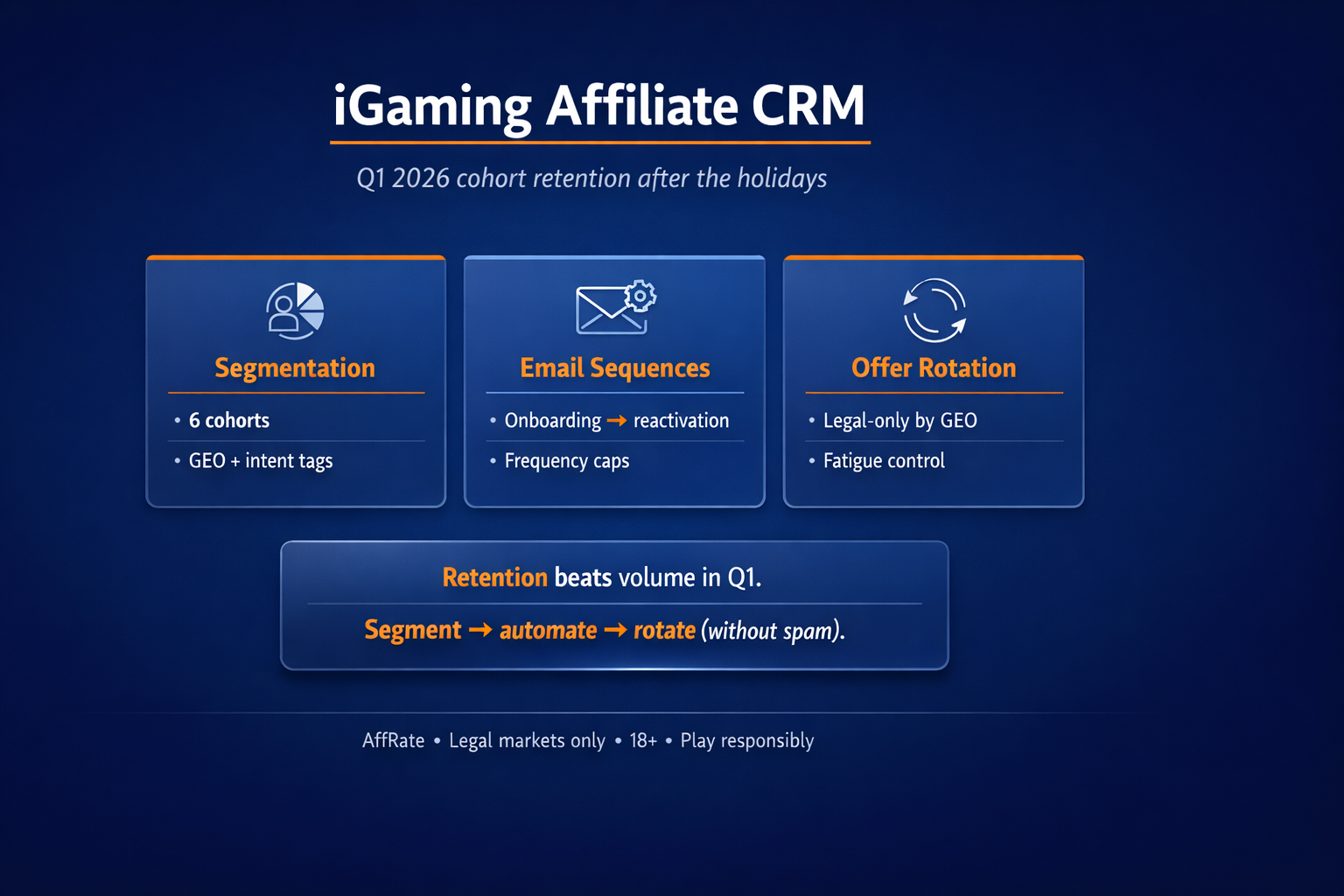
3) Segmentation for iGaming affiliate CRM: the 6 cohorts to run in Q1
Segmentation is the “engine.” Email sequences are the “transmission.” Offer rotation is the “traction.” Therefore, start with cohorts that are easy to explain and easy to automate.
3.1 The 6 practical Q1 cohorts (with triggers)
- Fresh holiday cohort (0–7 days): opted in during Q4/Q1 promos; needs onboarding and preferences.
- Engaged readers (clicked in last 14 days): high intent; can tolerate more offer content.
- Sports calendar cohort: clicks on sports betting content; wants “what’s on” + odds context.
- Casino value cohort: clicks slots/casino reviews; prefers product comparisons and terms clarity.
- Deal-only cohort: clicks only on bonus-heavy CTAs; needs tighter frequency + offer rotation limits.
- Dormant / sleepy (no open 30–60 days): requires reactivation or suppression to protect deliverability.
3.2 Q1 segmentation matrix (what you send + what you avoid)
| Cohort | Cadence | Email content mix | Offer rotation rule | Deliverability guardrail |
|---|---|---|---|---|
| Fresh holiday (0–7d) | 3–4 emails / 10 days | 70% value + 30% offer | 1 primary offer, rotate only after preference capture | Stop sequence if no opens after email #2 |
| Engaged readers | 1–2 / week | 50% content + 50% offer | Rotate weekly across 2–3 licensed partners per GEO | Exclude those with recent complaints/unsubs |
| Sports calendar | 1 / week + event spikes | “What’s on” + markets explainer | Rotate by sport/event + availability | Avoid over-sending if spam rate rises |
| Casino value | 1 / week | reviews, RTP explainer, terms clarity | Rotate by feature (payout speed, UX, games) | Keep subject lines non-spammy, clear intent |
| Deal-only | 1 / week max | short offers + strong terms summary | Hard cap: 1 bonus pitch per email | Suppress if no clicks after 3 sends |
| Dormant 30–60d | 2–3 emails / 14 days | reactivation + preference refresh | Only show “soft” offers after re-engagement | Sunset if no opens → protect domain |

4) Email sequences in an iGaming affiliate CRM (ready-to-copy flows)
Email sequences are where Q1 retention actually happens. Moreover, the winning sequences don’t “sell harder”—they sort faster. Every email should push the subscriber into a clearer bucket: sportsbook vs casino, deal-only vs value-first, and GEO availability.
4.1 Sequence A: Post-holiday onboarding (10 days)
Goal: capture preferences, set expectations, and avoid early churn. Therefore, keep the first emails value-led and short.
- Trigger: new subscriber + cohort_source in {black_friday, christmas, new_year}
- Exit conditions: if no opens after email #2 → move to low-frequency track
- Offer rule: one primary partner per GEO until preferences are known
Email 1 (Day 0): Welcome + preference capture
Subject ideas: “Welcome — pick your iGaming updates (sportsbook or casino?)” / “Quick preference check (30 seconds)”
Body structure:
- 1–2 lines: what they’ll get (weekly digest, legal-only, 18+).
- Preference CTA: choose sportsbook/casino/learn-first.
- RG microcopy: “Set limits. Don’t chase losses.”
Email 2 (Day 2): Value-first content
Subject ideas: “Q1 reset: the 3 mistakes that kill bankroll” / “How to read bonus terms in 60 seconds”
Additionally, this email is where you earn trust. Keep promos secondary and focus on clarity.
Email 3 (Day 5): First offer (geo-checked) + terms summary
Subject ideas: “This week’s pick (legal in your region)” / “Our verified pick + quick terms”
Include a 3–5 bullet terms summary and a clear disclosure near the CTA.
Email 4 (Day 8): Split path (sportsbook vs casino)
Subject ideas: “Sportsbook: what’s coming up” / “Casino: best value features to compare”
As a result, you convert “generic subscribers” into intent-driven cohorts you can retain.
4.2 Sequence B: Q1 “soft reactivation” (14 days)
Goal: re-engage without spiking spam complaints. In contrast to hard-sell blasts, reactivation works better with preference refresh and a single high-clarity offer.
- Trigger: dormant_30d (no opens in 30 days) OR no clicks in 45 days
- Guardrail: if they stay inactive → sunset to protect deliverability
Email 1 (Day 0): “Still want these updates?”
Subject ideas: “Should we keep sending?” / “One-click preference update”
Offer a preference link and a “pause” option. Therefore, your list gets cleaner and your inbox placement improves.
Email 2 (Day 4): One value piece + one offer (max)
Subject ideas: “A safer way to compare offers (terms first)”
Email 3 (Day 10): Last call + sunset
Subject ideas: “Last email unless you click”
At the same time, be transparent: tell them you’ll stop emailing if there’s no engagement.
4.3 Sequence C: Weekly digest with controlled offer rotation
This is your “evergreen” retention engine. Moreover, it’s the safest place to rotate offers because the reader expects a recap, not a surprise promo.
- Structure: 1) “What’s on” 2) 1 explainer 3) 1–2 offers (geo-checked) 4) RG microcopy
- Rotation rule: rotate offers, not your voice. Keep tone and layout consistent.
- Cap: don’t exceed 2 primary CTAs in one email for broad segments.
Deliverability note: if your email volume approaches bulk-sender territory, align your authentication and unsubscribe flows early. Our internal Email Deliverability for Affiliates guide is a good operational checklist.
5) Offer rotation for iGaming affiliate CRM: keep cohorts engaged (without list fatigue)
Offer rotation is not “random link swapping.” Instead, it’s controlled distribution: you decide which partner is shown to which cohort, in which GEO, on which cadence, and with which claims.
5.1 The 3-layer offer rotation framework
- Eligibility layer: only show offers legal/available for the subscriber’s location.
- Intent layer: sportsbook vs casino vs learn-first content blocks.
- Fatigue layer: rotation cadence + caps (how often a user sees the same partner).
5.2 A Q1 rotation calendar that feels personal
Build a simple quarterly rhythm. For example, many teams run:
- Week A: “education + comparison” email (lighter promo, higher trust)
- Week B: one hero offer (geo-checked) + strong terms summary
- Week C: alternative offer (different operator or different feature angle)
- Week D: “seasonal” recap + preference refresh
5.3 Rotation rules that protect compliance (and keep partners happy)
- Never rotate into unknown GEOs: if GEO is missing/uncertain, show a neutral content hub instead of a bonus CTA.
- Rotate the feature angle: “fast payouts” week, “UX / app” week, “market depth” week—so you’re not shouting “best bonus” every time.
- Include terms summaries: it reduces complaints and improves trust.
- Keep an offer-change log: when a partner updates terms, your CRM content should update too.

6) WordPress + iGaming affiliate CRM: implementation checklist
WordPress is still the easiest “content + capture” engine for affiliates. However, your CRM only works if WordPress collects clean consent, clean GEO signals, and clean preferences.
6.1 The signup form (what to include, what to avoid)
- Must include: explicit opt-in checkbox, unsubscribe language, and an 18+ confirmation.
- Should include: interest selector (sportsbook/casino/learn-first) and optional GEO dropdown.
- Avoid: pre-checked boxes, confusing consent language, and “bait” lead magnets that don’t match your actual newsletter content.
6.2 Copy-paste WP block: Above-the-fold newsletter signup (18+ + legal-only)
<!-- AFFRATE NEWSLETTER SIGNUP (CRM READY) -->
<aside class="affrate-callout affrate-newsletter" role="note">
  <strong>Get weekly iGaming updates (legal markets only).</strong><br />
  Choose your focus: sportsbook • casino • learn-first.<br />
  <em>18+ only. Opt out anytime. Play responsibly.</em>
</aside>
6.3 Copy-paste WP block: Offer module with disclosure + terms summary
<!-- AFFRATE OFFER MODULE (SAFE DEFAULT) -->
<section class="affrate-offer">
  <p><strong>#ad:</strong> Affiliate offer (legal regions only). 18+ only. Play responsibly.</p>
  <h4>Offer highlight (quick summary)</h4>
  <ul>
    <li>Eligibility: 18+ • location rules apply</li>
    <li>Key terms: wagering/playthrough, expiry, max cashout (if applicable)</li>
    <li>Full terms: link to operator T&Cs</li>
  </ul>
  <p><a href="#">Check availability</a></p>
</section>
6.4 Implementation tip: build a “preference center” page
A preference center reduces unsubscribes because it offers a middle option: “send less,” “sports only,” or “casino only.” Consequently, your engaged segments stay strong even when Q1 interest drops.

7) Compliance & Responsible Gambling for iGaming affiliate CRM
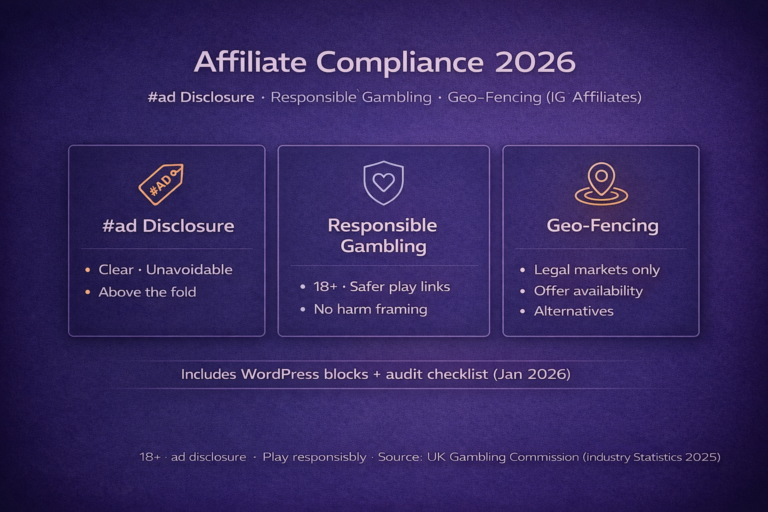
In regulated iGaming, compliance is not a “footer link.” It’s a workflow: disclosures, RG messaging, geo-fencing, and controlled claims. Moreover, your CRM amplifies risk because one mistake can be sent to thousands of people.
7.1 #ad disclosure placement in emails and money pages
Put disclosure where a user can’t miss it: above the fold on pages and near the CTA in emails. Additionally, avoid vague phrasing. Use plain language like “#ad” or “affiliate links” so intent is obvious.
7.2 Responsible Gambling (RG) messaging that doesn’t kill conversions
RG doesn’t need to be long. It needs to be visible, consistent, and honest. Therefore, standardize a short RG line and keep it in every email and on every promo hub.
RG resources: If gambling stops being fun, use local support and self‑exclusion tools. See our Responsible Gambling page for region links.
7.3 GEO/legal-only: stop sending the wrong offer to the wrong place
Geo mistakes are expensive: partner complaints, program removal, or worse. As a result, maintain a simple matrix: GEO → licensed partners → allowed claims → landing URLs. If GEO is unknown, show a neutral informational alternative.
7.4 Ontario and inducement-style messaging (special caution)
Ontario’s regulated market is unusually strict on public promotion of bonuses/inducements. Consequently, if you have Ontario traffic, be extra careful with bonus-led email copy and public-facing pages, and verify what is allowed for your specific partners and channels.
7.5 Mid-funnel compliance audit (weekly habit)
- Are disclosures visible before the first CTA?
- Do emails clearly read as marketing (not disguised personal mail)?
- Do offers match the subscriber’s GEO and legal availability?
- Are bonus terms summarized and not misleading?
- Is RG microcopy present and consistent?

8) KPI dashboard: measure cohort retention in Q1 2026
Without a dashboard, “retention” becomes vibes. Therefore, track a small set of metrics weekly, per cohort and per GEO.
8.1 The KPI set that matters (affiliate-side)
| Metric | Why it matters | Healthy direction |
|---|---|---|
| Cohort active rate (30d) | How many subscribers still open/click | Up or stable |
| Click rate (by cohort) | Intent and offer fit | Up after segmentation improvements |
| Unsubscribe rate | Fatigue + mismatch | Down as preference center improves |
| Spam complaint signals | Inbox placement risk | Down; take action fast |
| EPC (by GEO + cohort) | Monetization efficiency | Up as rotation becomes controlled |
8.2 Q1 testing backlog (simple A/Bs that compound)
- Subject lines: “terms-first” vs “bonus-first” framing.
- Cadence: 1/week vs 2/week for engaged cohorts only.
- Offer module: single hero offer vs two smaller offers.
- Terms summary: present vs absent (watch complaints/unsubs).
- Preference capture: signup asks interest vs no interest (watch cohort segmentation quality).
9) Templates: segmentation tags, email copy, rotation sheet
Below are copy-ready building blocks. Additionally, they’re designed to be “safe defaults” for regulated markets.
9.1 Tag schema (copy/paste)
- cohort_source:new_year_2026
- geo:uk
- geo:us_nj
- geo:ca_on
- intent:sportsbook
- intent:casino
- engagement:engaged_14d
- engagement:dormant_30d
- risk_flags:rg_sensitive
9.2 Email footer microcopy (universal)
#ad / affiliate: This email may contain affiliate links.
18+ only. Legal regions only. Offers vary by location and terms.
Gamble responsibly — set limits and never chase losses.
Unsubscribe or manage preferences anytime.
9.3 Offer rotation worksheet (simple columns)
- GEO
- Vertical
- Primary partner (week A)
- Secondary partner (week B)
- Feature angle (payouts / UX / markets / terms clarity)
- Allowed claims
- Required terms snippet
- Landing URL
- Last updated

10) FAQ: iGaming affiliate CRM in regulated markets
Do affiliates really need a CRM if operators do retention?
Yes—because you’re retaining your audience, not the operator’s player base. Consequently, a strong audience CRM stabilizes traffic and makes your revenue less seasonal.
How often should I email in Q1?
Start conservative: 1/week for broad cohorts, 2/week only for engaged cohorts. Moreover, add frequency caps and sunset rules to protect deliverability.
What’s the fastest segmentation win?
Preference capture at signup. Additionally, a “sportsbook vs casino” split immediately improves relevance and reduces unsubscribes.
What’s the safest way to rotate offers?
Rotate within a GEO-approved set of licensed partners, and rotate the feature angle more than the “bonus headline.” Therefore, your messaging stays informative and less complaint-prone.
Where do I learn the compliance basics for affiliate pages and emails?
Start with our internal compliance playbook: Affiliate Compliance 2026, then adapt it to your GEOs and operator terms.
Sources (verified January 12, 2026)
- Federal Trade Commission (FTC) — Endorsement Guides: What People Are Asking
- Advertising Standards Authority (ASA) / CAP Code — Recognition of marketing communications (Section 2)
- UK Gambling Commission — Affiliates or third parties (direct marketing responsibility)
- UK ICO — Guidance on direct marketing using electronic mail (PECR)
- Google Workspace Admin Help — Email sender guidelines FAQ (Gmail requirements)
- Alcohol and Gaming Commission of Ontario (AGCO) — Submission to the Senate Committee on sports betting advertising (PDF)